


Dr. Reyaz Ahmad
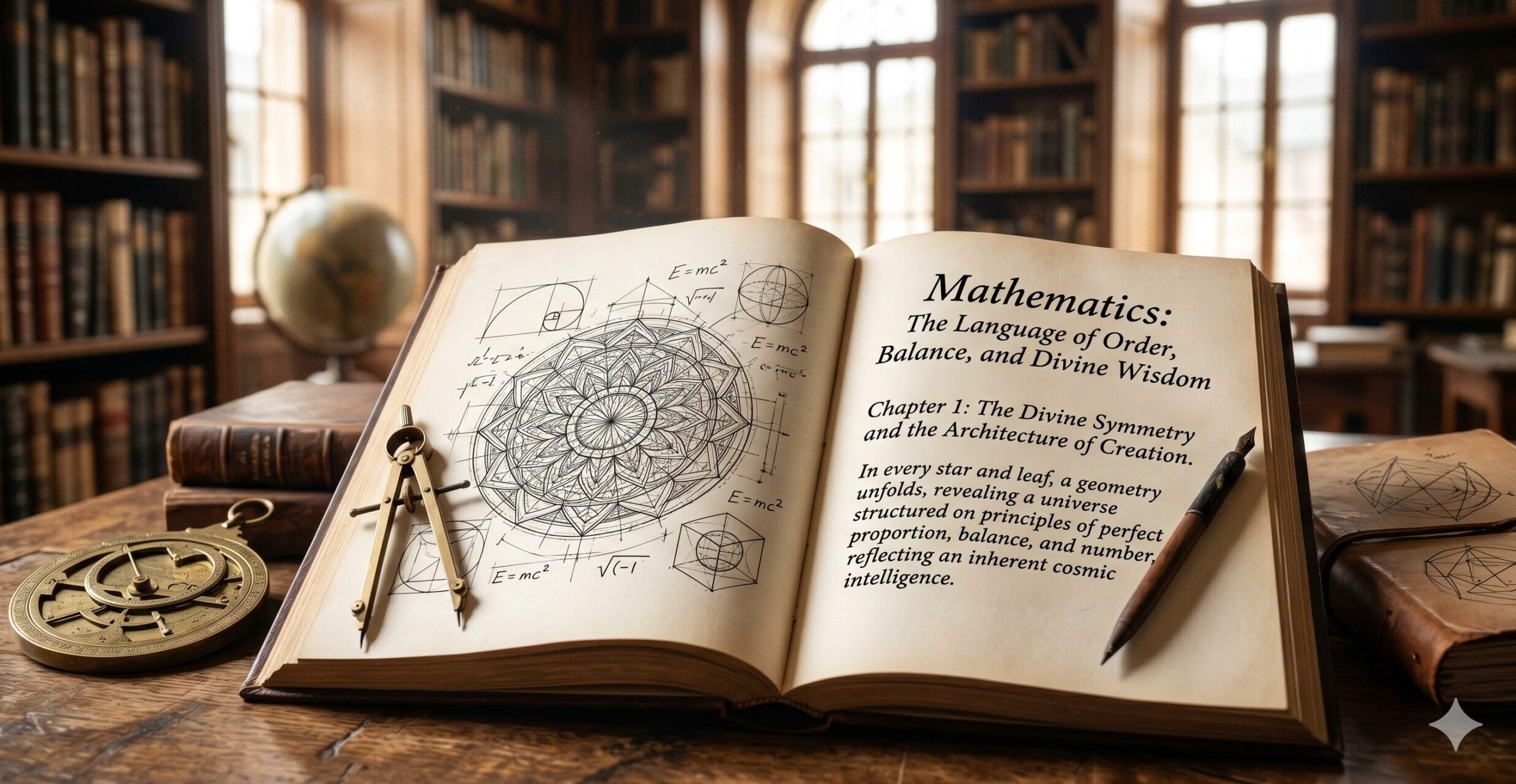
Mathematics is often misunderstood as a dry subject of numbers, formulas, and calculations. Many students see it only as a classroom requirement, many adults remember it as a difficult academic burden, and many societies treat it as a technical discipline limited to engineers, scientists, accountants, and economists. But this narrow view does not do justice to the real spirit of mathematics. Mathematics is not merely about solving equations; it is about understanding order. It is not simply the art of counting; it is the discipline of reasoning, measuring, balancing, comparing, and discovering patterns in the world around us.
From the movement of planets to the rhythm of time, from the balance of justice to the division of inheritance, from the structure of nature to the responsibilities of human life, mathematics silently operates everywhere. It is one of the most powerful languages through which human beings understand creation. Interestingly, the Qur’an itself repeatedly draws attention to calculation, number, proportion, measure, balance, and order. This does not mean that the Qur’an is a mathematics textbook. Rather, it means that the Qur’an invites human beings to reflect on the mathematical structure of the universe and to recognize that creation is not random, chaotic, or meaningless.
One of the most powerful Qur’anic references to mathematical order appears in Surah Ar-Rahman: “The sun and the moon move according to precise calculation” (55:5). The Arabic word ḥusbān is closely related to calculation, reckoning, and measured movement. This short verse contains a profound intellectual message. The sun and the moon do not move carelessly. Their motion is not accidental. Their rising, setting, phases, and cycles follow a precise order. Human beings discovered calendars, seasons, timekeeping, navigation, and astronomy by studying this order. In other words, the heavens themselves teach us that mathematics is built into the structure of the universe.
The Qur’an makes this idea even clearer in Surah Yunus, where it says that Allah made the sun a shining light and the moon a reflected light, and determined phases for the moon “so that you may know the number of years and the calculation” (10:5). Here, two important mathematical ideas are directly mentioned: number and calculation. Time is not only experienced emotionally; it is also measured mathematically. Days, months, years, calendars, fasting schedules, pilgrimage dates, agricultural seasons, and social planning all depend upon mathematical calculation. Without mathematics, human society would lose one of its most basic organizing systems: the measurement of time.
This is why mathematics must not be reduced to examination marks alone. A society that neglects mathematics weakens its ability to plan, measure, forecast, organize, and make responsible decisions. The Qur’an’s attention to calculation reminds us that mathematical thinking is part of disciplined living. A person who understands calculation learns precision. A community that values calculation learns accountability. A civilization that respects mathematical order learns to build calendars, institutions, architecture, economies, and technologies.
Another important Qur’anic idea is that everything has been created with measure. Surah Al-Qamar states: “Indeed, We created everything according to measure” (54:49). The word qadar carries meanings of measure, proportion, limit, and determined quantity. This is an extraordinary statement about the nature of reality. The universe is not a disorderly collection of objects. It is full of proportion and structure. The human body has proportions. Plants grow according to patterns. The planets move in orbits. Sound, light, force, energy, and motion can all be described through mathematical relationships. Modern science, in many ways, is the study of this measured order.
The same idea can be observed in daily life. A medicine must be given in the correct dose. A building must be constructed with accurate measurements. A bridge must be designed with correct calculations. A business must calculate cost, revenue, profit, and risk. A family must plan income and expenditure. Even cooking requires proportion. Too much salt can spoil food; too little support can weaken a structure; an incorrect calculation can cause financial loss or engineering failure. Mathematics, therefore, is not separated from life. It is life understood with discipline and precision.
The Qur’an also connects mathematical balance with moral responsibility. In Surah Ar-Rahman, Allah says that He raised the heaven and established the balance, and commands human beings not to violate the balance and to establish weight with justice (55:7–9). The word mīzān refers to balance, scale, proportion, and justice. This is a deeply meaningful connection. Mathematics is not only about numbers; it is also about fairness. A correct weight in the market is a mathematical matter, but it is also an ethical matter. A fair distribution of resources is a numerical matter, but it is also a moral matter. A dishonest measurement is not merely a technical error; it is an injustice.
This teaches us that mathematics has an ethical dimension. When numbers are manipulated, people suffer. False statistics can mislead nations. Wrong financial calculations can exploit the poor. Biased data can create unjust policies. Incorrect measurements can endanger lives. Therefore, mathematics must be taught not only as a technical skill but also as a responsibility. The Qur’anic concept of balance reminds us that the purpose of measurement is not manipulation, but justice.
Perhaps one of the clearest practical examples of mathematics in the Qur’an is found in the laws of inheritance in Surah An-Nisa (4:11–12). These verses mention shares such as one-half, one-fourth, one-eighth, two-thirds, one-third, and one-sixth. These are mathematical fractions, but they are also part of a legal and moral system. The purpose is to ensure that wealth is not distributed according to emotion, pressure, or power, but according to a defined and accountable structure. This shows that mathematics can protect rights. It can prevent injustice. It can make decisions transparent.
In inheritance, a small mathematical error can create a major human conflict. A wrong fraction can deprive someone of their rightful share. This demonstrates that mathematics is not an abstract luxury; it is a tool for justice in family and society. The Qur’an’s use of fractions in inheritance shows that accurate calculation is necessary for responsible social life.
The Qur’an also uses numerical expression in a powerful way. In Surah Al-Ankabut, it is stated that Prophet Nuh remained among his people for “a thousand years minus fifty years” (29:14). This expression itself involves subtraction: 1000 minus 50 equals 950 years. The style is not merely numerical; it is rhetorical and reflective. It invites attention. It makes the reader pause and think. Numbers in the Qur’an are not meaningless decorations; they often carry lessons, emphasis, and intellectual value.
Similarly, Surah Al-Jinn states that Allah has “counted everything in number” (72:28). This verse reinforces the idea that creation is known, measured, and encompassed by divine knowledge. Human beings count in order to understand a small part of reality. Divine knowledge encompasses all reality. This distinction should make human beings humble. Mathematics gives us power, but it should not make us arrogant. It allows us to discover patterns, but it does not make us the owners of creation. It teaches us both confidence and humility.
The argument, therefore, is clear: mathematics is not alien to faith, life, morality, or civilization. It is deeply connected with all of them. The Qur’an does not ask us to escape from calculation; it asks us to observe, measure, think, and reflect. It presents a universe based on order, not chaos; balance, not excess; proportion, not randomness; accountability, not confusion.
In the modern world, this message is more important than ever. We live in an age of data, artificial intelligence, finance, engineering, medicine, climate science, and digital technology. Every major decision today involves numbers. Governments use statistics. Doctors use measurements. Economists use models. Engineers use calculations. Teachers use assessment data. Businesses use forecasting. Even social media uses algorithms. A person who cannot understand numbers becomes vulnerable to misinformation, manipulation, and poor judgment.
But mathematics must be humanized. It should not be taught as fear. It should be taught as a way of seeing. Students should be told that when they study mathematics, they are not merely preparing for exams; they are learning the language of accuracy, truth, order, and responsibility. They are learning how the moon marks time, how balance protects justice, how fractions protect rights, and how measurement supports civilization.
Mathematics, in this broader vision, becomes more than a subject. It becomes a discipline of the mind and a training of character. It teaches patience because solutions require steps. It teaches honesty because the answer must be correct. It teaches discipline because careless thinking leads to error. It teaches humility because even a small mistake can change the result. It teaches hope because every complex problem can be approached step by step.
The Qur’anic worldview gives mathematics a noble place. It reminds us that the universe is intelligible, that creation has measure, that time can be calculated, that justice requires balance, and that human life needs accountability. Mathematics is therefore not just the science of numbers; it is the language of order, the structure of responsibility, and one of the signs through which thoughtful people can recognize wisdom in creation.
In the end, mathematics should not be feared as a difficult subject. It should be respected as a gift of understanding. It helps us read the universe, organize society, protect justice, and discipline our own thinking. The Qur’an does not present mathematics as a cold calculation separated from life; it presents calculation, number, measure, and balance as signs of a meaningful and ordered reality. To study mathematics, therefore, is not merely to solve problems on paper. It is to learn how to see the world with clarity, fairness, and wonder.
Author Can be Mailed At reyaz56@gmail.com


