


Dr.Reyaz Ahmad
The world is entering a period in which stability can no longer be taken for granted. Jobs that once appeared secure are disappearing. Technology is changing entire professions. Artificial intelligence is performing tasks that previously required years of education and experience. Economic uncertainty, climate disruption, political instability, global competition and rapidly changing social expectations are creating a future that will reward the adaptable and expose the unprepared.
The warning is not that everyone should live in fear. The warning is that no one can afford to remain passive.
The next five years may not be difficult merely because opportunities will become fewer. They may be difficult because the nature of opportunity itself is changing. A qualification that was valuable yesterday may not guarantee employment tomorrow. A business model that succeeded for decades may suddenly become irrelevant. A profession considered prestigious today may be transformed by automation, digital platforms or new consumer behaviour.
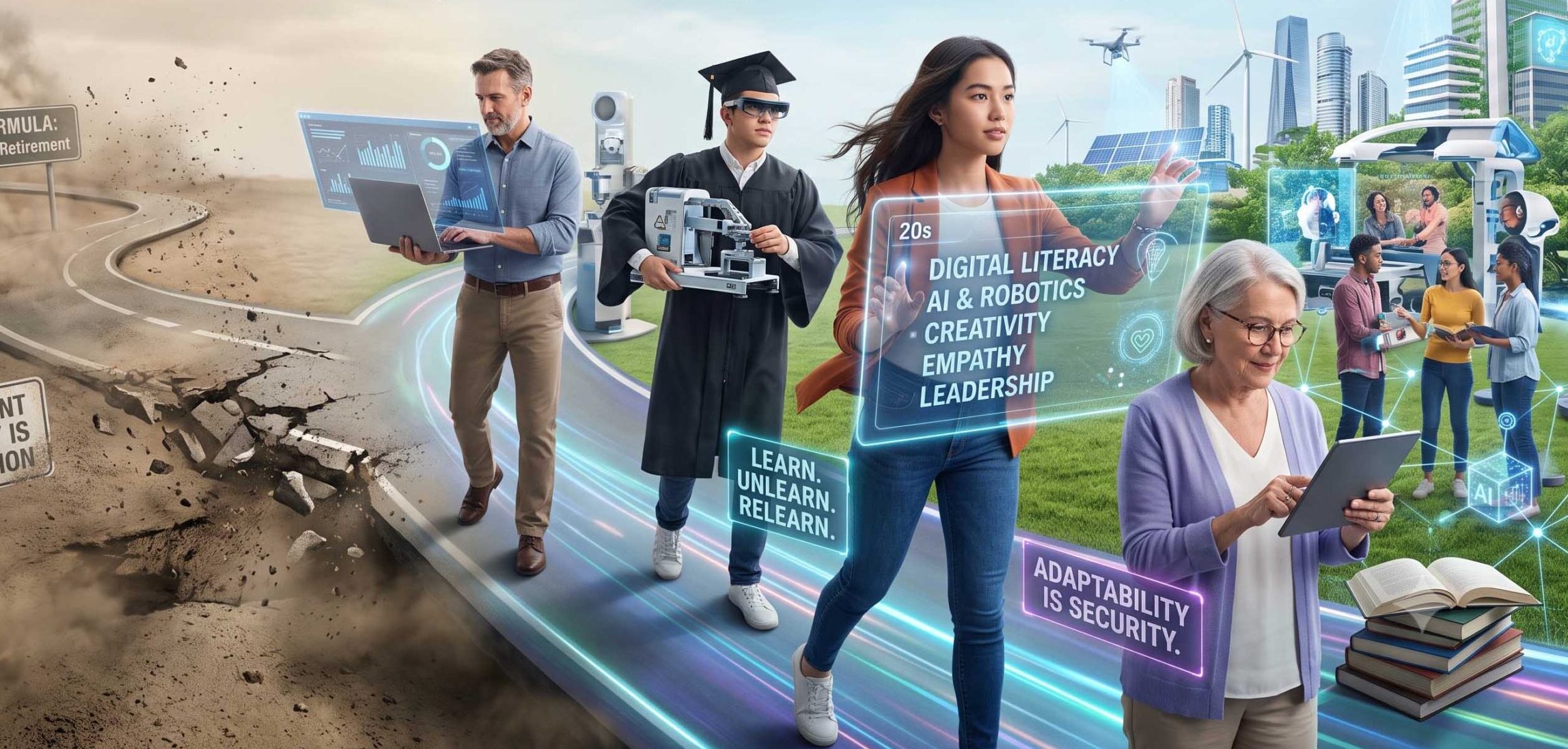
In such an environment, survival will not belong only to the most intelligent, the most educated or the most experienced. It will increasingly belong to those who can learn, unlearn, relearn and adjust.
The Dangerous Illusion of Permanent Security
For generations, people were encouraged to follow a predictable formula: obtain a degree, secure a job, work faithfully for several decades and retire with financial security. That formula worked for many people in a relatively stable industrial economy.
But the modern world no longer operates according to such predictable rules.
Companies restructure without warning. Institutions close. Industries move from one country to another. Technology replaces routine tasks. Employers increasingly prefer flexible workers who possess multiple skills rather than employees who depend on one narrow specialisation. Even highly qualified professionals are discovering that degrees alone cannot protect them from disruption.
The greatest danger, therefore, is not change itself. The greatest danger is believing that change will not affect us.
Many people continue to live as though their present salary, profession, business or social position will remain permanent. They postpone learning new skills. They avoid technology. They refuse to explore alternative sources of income. They depend entirely on one employer, one qualification or one professional identity.
Such dependence may feel comfortable today, but it can become a serious weakness tomorrow.
Adaptability Is the New Form of Security
In the emerging world, security will not come from holding one permanent position. It will come from possessing the ability to remain useful under changing conditions.
Adaptability means more than learning how to use a new device or application. It means developing the mental courage to accept that old methods may no longer be sufficient. It means being willing to change direction when circumstances demand it. It means refusing to allow pride, age, habit or fear to prevent personal growth.
An adaptable teacher does not merely repeat the same lecture notes for twenty years. The teacher learns digital methods, understands artificial intelligence, updates classroom practices and prepares students for modern realities.
An adaptable employee does not say, “This is not part of my job.” The employee asks, “What new capability must I develop to remain valuable?”
An adaptable businessperson studies changing markets rather than blaming customers for changing their preferences.
An adaptable young graduate does not wait endlessly for the perfect job. The graduate builds practical skills, creates a portfolio, accepts temporary opportunities, explores entrepreneurship and develops professional networks.
Adaptability is not the abandonment of one’s identity. It is the intelligent expansion of one’s possibilities.
Young People Must Stop Waiting to Be Rescued
The current generation has access to more knowledge, technology and communication than any generation in history. Yet many young people remain trapped in a culture of waiting.
They wait for the government to provide employment. They wait for universities to guarantee careers. They wait for relatives to create opportunities. They wait for the economy to improve. They wait for someone to recognise their talent.
But waiting is not a survival strategy.
No government can create a suitable job for every graduate. No university can guarantee permanent employment. No certificate can protect a person who has stopped learning. Institutions can provide guidance and opportunities, but individuals must take responsibility for their own development.
This generation must understand a hard truth: the future will not always reward those who merely followed instructions. It will reward those who can identify problems, create solutions, communicate effectively, work across cultures and learn independently.
A degree may open the first door. Adaptability will determine whether the remaining doors continue to open.
Skills Must Replace Complacency
The coming years will require a serious reassessment of what it means to be educated.
Education cannot be reduced to passing examinations, memorising theories and collecting certificates. A genuinely educated person must be capable of applying knowledge in unfamiliar situations. He or she must be able to analyse information, solve problems, collaborate, communicate and make responsible decisions.
Every individual should now develop a combination of technical and human capabilities.
Digital literacy is no longer optional. Understanding artificial intelligence, data, online communication and basic technology has become essential in nearly every profession. At the same time, human qualities such as judgement, empathy, creativity, leadership, ethical reasoning and persuasive communication are becoming even more valuable because machines cannot easily reproduce them in their full depth.
People should also consider developing more than one source of income. A salaried position may remain important, but complete dependence on a single employer is increasingly risky. Teaching, consulting, freelancing, digital services, small enterprise, investment and specialised training can provide additional protection.
The objective is not to become restless or greedy. The objective is to become resilient.
Failure Must Be Treated as Information
One of the greatest obstacles to adaptability is the fear of failure.
Many people refuse to attempt something new because they are afraid of embarrassment. They would rather remain in an unsatisfactory situation than risk temporary discomfort. They interpret rejection as proof that they are incapable. They treat one failed application, one unsuccessful business attempt or one professional setback as the end of the road.
But in a changing world, failure must be treated as information.
A rejected application may reveal that a skill needs improvement. A failed business may expose a weakness in planning. A lost position may force a person to discover abilities that remained hidden during comfortable years.
Adaptable people do not romanticise failure, but neither do they allow it to define them. They examine it, learn from it and move forward with greater intelligence.
Survival has always depended on adjustment. Nature itself demonstrates this principle. The species that endure are not necessarily the strongest in every circumstance. They are those capable of responding to environmental change. Human societies, institutions and careers follow a similar pattern.
Experience Must Cooperate with Innovation
Adaptability is not a message only for the young. Older professionals must also resist the belief that learning belongs exclusively to youth.
Experience remains immensely valuable, but experience becomes powerful only when it cooperates with innovation. A senior professional who combines decades of wisdom with modern technology may be more valuable than a younger person who possesses technical knowledge but lacks judgement.
Age should not become an excuse for withdrawal. Nor should youth become an excuse for arrogance.
The future requires intergenerational cooperation. Younger people can bring technological confidence, speed and new perspectives. Older people can contribute patience, institutional memory, ethical understanding and mature judgement. Societies that unite these strengths will be better prepared than those that allow generations to dismiss one another.
Preparation Must Begin Before the Crisis
The worst time to begin preparing for unemployment is after losing a job. The worst time to develop digital skills is after one’s profession has already been transformed. The worst time to build savings is after income has stopped.
Preparation must begin while conditions are still manageable.
Families should discuss financial discipline. Professionals should update their skills regularly. Students should build practical portfolios alongside academic qualifications. Employees should cultivate networks before they urgently need assistance. Businesses should study future trends rather than relying entirely on past success.
Emergency savings, continuous learning, good health, professional relationships and diversified skills are no longer luxuries. They are elements of modern survival.
Preparedness should not create panic. It should create confidence. A person who has alternatives is less likely to collapse when one door closes.
The Time to Change Is Now
The message for the current generation is clear: do not expect the future to resemble the past.
The coming years may be demanding, but difficulty does not mean defeat. Periods of disruption also create new industries, professions and possibilities. Every technological revolution destroys certain forms of work while creating others. Every economic transition produces both losses and opportunities.
The decisive question is whether we will recognise those opportunities in time.
Those who remain trapped in outdated assumptions may experience change as a threat. Those who remain alert, disciplined and willing to learn may experience the same change as an opening.
The future will not ask how comfortable we were with yesterday’s methods. It will ask whether we were courageous enough to prepare for tomorrow.
This is not the time for despair. It is the time for awareness.
Not the time for panic, but for preparation.
Not the time to complain endlessly about change, but to develop the capacity to navigate it.
The next five years may indeed be difficult. But difficulty does not destroy prepared people; it reveals them. The individuals and communities that survive and progress will be those that refuse to remain intellectually, professionally and financially motionless.
In the world that is coming, adaptability will not merely be a desirable quality.
It will be the difference between dependence and independence, vulnerability and resilience, decline and survival.
(The author works at the Faculty of Mathematics,Department of General Education HUC, Ajman, UAE)


