


Dr.Reyaz Ahmad
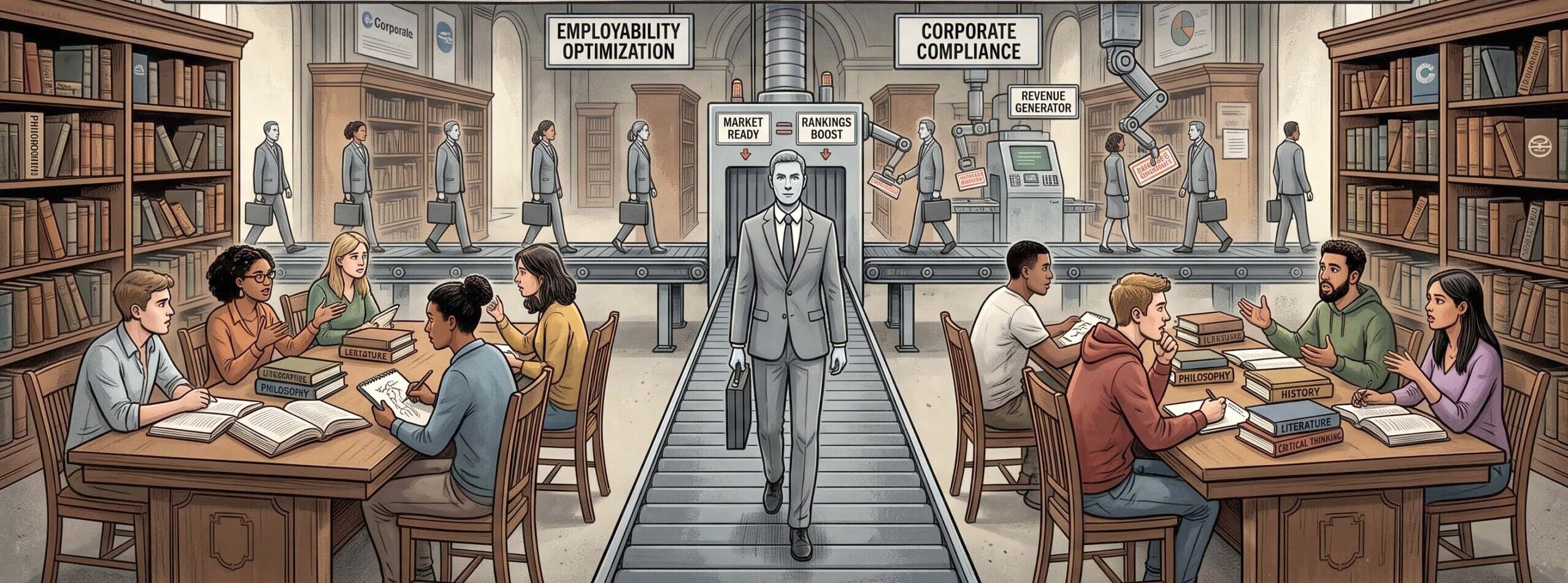
Higher education must prepare students for work—but when employability, rankings and revenue become its defining purpose, the university risks losing the very reason it exists.
There is a question that universities rarely ask themselves because it is far easier to discuss rankings, accreditation, graduate employment rates and research output:
What exactly is a university for?
Is its primary purpose to produce employees who can be absorbed efficiently into the labour market? Is it an advanced training centre designed to supply corporations with skilled workers? Is it a research factory competing for grants, citations and institutional prestige? Or is a university supposed to do something deeper—to create intellectually independent human beings capable of questioning assumptions, examining power, judging evidence and thinking beyond the immediate demands of the market?
The question is no longer philosophical decoration. It lies at the centre of the crisis confronting modern higher education.
Universities today face enormous pressure to prove their economic usefulness. Students and parents understandably ask whether a degree will lead to employment. Governments demand evidence of graduate outcomes. Employers want industry-ready graduates. Accrediting bodies require measurable performance indicators. International rankings reward research visibility. Universities compete for students, faculty, grants and reputation.
None of these concerns is illegitimate.
The danger begins when they cease to be components of education and become its definition.
When Education Becomes a Transaction
A student enters university.
He pays tuition.
He completes courses.
He receives a degree.
He obtains employment.
From an economic perspective, the process seems perfectly rational:
Education → Qualification → Employment → Income
Universities therefore increasingly market degrees through the language of return on investment: employability, salary potential, career progression and industry relevance.
There is nothing wrong with wanting graduates to find good jobs. A university that ignores the economic realities facing its students would itself be irresponsible.
But something important disappears when we reduce education entirely to this equation.
A graduate is not merely a future employee.
A student is also a future citizen, parent, decision-maker, voter, entrepreneur, professional and member of society.
The university must therefore prepare people not simply to earn, but also to judge.
The difference is profound.
Training tells a person how to perform a task.
Education should also teach that person when the task is worth performing, what consequences it may produce and whether the assumptions behind it deserve questioning.
The Tyranny of What Can Be Measured
Modern institutions understandably depend upon measurement.
Universities count publications, citations, grants, enrolments, graduation rates, employability percentages, student satisfaction scores and international rankings.
Measurement provides accountability.
But education contains an uncomfortable truth:
Many of the things that matter most cannot easily be measured.
How do we assign a numerical score to intellectual courage?
What metric captures curiosity?
What ranking measures whether a student has learned to recognise a weak argument?
Which dashboard tells us whether a graduate possesses moral judgment?
How many citations prove that a university has taught someone to think independently?
An institution can become highly successful according to measurable indicators while gradually becoming intellectually impoverished.
This produces a dangerous institutional temptation:
We begin valuing what we can measure rather than learning how to measure what we truly value.
Research itself can fall into this trap.
Universities need research. Knowledge advances through scholarship, experimentation and sustained intellectual inquiry.
Yet when faculty careers depend excessively upon publication counts and citation indexes, scholarship can slowly become another production line:
publish→ accumulate citations → improve rankings → attract funding → publish more.
The question “Is this worth understanding?” risks being replaced by “Can this be published?”
That is not a rejection of research.
It is a warning against confusing research productivity with intellectual significance.
But Universities Cannot Ignore Employment
Critics of this argument will raise a powerful objection.
What good is philosophical freedom to a graduate who cannot find employment?
Families often make enormous financial sacrifices for higher education. Students take loans. Governments subsidise universities. Employers complain about skills shortages.
Surely universities have a responsibility to prepare students for economic life.
They do.
The false choice is believing we must select either humanistic education or employability.
A successful university should achieve both.
Indeed, the abilities most valuable in a rapidly changing labour market are increasingly the same abilities associated with genuine education:
Critical thinking,
Communication,
Quantitative reasoning,
Adaptability,
Creativity,
Ethical judgment,
Problem solving,and the ability to learn independently.
Technology strengthens rather than weakens this argument.
Artificial intelligence can increasingly perform routine analysis, generate reports, write computer code, summarise documents and automate repetitive intellectual tasks.
If universities respond by turning students into increasingly specialised operators of present-day technologies, they may prepare graduates for jobs that disappear before their careers mature.
The safest preparation for an unpredictable future is therefore not narrow training.
It is intellectual adaptability.
The future will reward people capable not merely of knowing answers but of asking better questions.
The Corporate University
Another criticism concerns the growing corporate character of universities.
A university must certainly be financially sustainable. Buildings cost money. Laboratories cost money. Faculty salaries must be paid. Technology, libraries and student services require substantial investment.
Financial discipline is necessary.
But the university becomes vulnerable when commercial logic begins governing academic logic.
Students gradually become customers.
Courses become products.
Faculty become service providers.
Degrees become credentials.
Research becomes output.
University leaders become brand managers.
And education becomes a marketplace transaction.
The customer-service analogy is particularly dangerous.
A student is not exactly a customer because education sometimes requires telling students things they do not want to hear.
“You need to work harder.”
“Your argument is weak.”
“Your calculation is incorrect.”
“Your evidence does not support your conclusion.”
“This assignment is not good enough.”
A serious university must occasionally frustrate students in order to educate them.
A restaurant fails when it refuses to satisfy its customer.
A university may fail precisely because it satisfies students too easily.
What, Then, Should Change?
The solution is not to destroy the modern university system.
It is to restore balance.
First, employability should remain an outcome, not become the philosophy of education.
Universities should prepare students for careers while making clear that a degree has purposes extending beyond employment.
Every graduate should leave university not merely with professional competence but with strengthened reasoning, communication and judgment.
Second, universities should protect intellectual breadth.
Engineering students should encounter ethics.
Business students should study society and history.
Humanities students should understand data and quantitative reasoning.
Scientists should learn communication and philosophy of evidence.
Mathematics students should understand how abstract reasoning connects with human decisions.
Specialisation creates expertise.
Breadth creates perspective.
Society needs both.
Third, assessment must move beyond memorisation.
In an age when information is instantly searchable and AI can generate routine answers, education should increasingly assess:
Interpretation,
Argument,
Problem solving,
Application,
Evaluation,
Original reasoning,
And the ability to defend conclusions.
The examination question of the future should not merely ask:
“What do you know?”
It should ask:
“What can you do with what you know?”
Fourth, research quality should matter more than research quantity.
Universities should resist cultures in which academics feel compelled to produce papers primarily to satisfy numerical targets.
A smaller amount of meaningful scholarship can sometimes contribute more than a large volume of marginal publication.
Fifth, faculty must recover their role as educators.
The most important relationship in a university remains surprisingly old-fashioned:
a knowledgeable teacher helping another human being learn how to think.
Technology should strengthen that relationship, not replace it.
Artificial intelligence can explain, simulate, calculate and personalise.
But education ultimately requires judgment, mentorship, intellectual challenge and human example.
The University as a Place of Freedom
The deepest purpose of a university may therefore be neither employment nor research alone.
It is the cultivation of intellectual freedom.
A genuinely educated person should be able to encounter an argument and ask:
What is the evidence?
What assumptions are being made?
Who benefits if I believe this?
Is the conclusion logically justified?
What alternatives exist?
What are the consequences?
And perhaps most importantly:
Could I be wrong?
A society filled with technically skilled people who cannot ask these questions may become prosperous.
It may not remain wise.
Universities therefore carry a responsibility extending far beyond campuses.
They help shape the intellectual habits of societies.
The Question We Should Ask Every Graduate
Perhaps universities should reconsider the question they place before students.
Instead of asking only:
“What job will this degree help you get?”
we should also ask:
“What kind of person will this education help you become?”
The first question matters.
The second determines the future of civilisation.
Universities should prepare engineers who can design bridges—but also recognise when public safety is being compromised.
They should produce business leaders capable of creating wealth—but also understanding the consequences of exploitation.
They should educate scientists capable of advancing technology—but also asking whether every technological possibility should automatically become reality.
They should train mathematicians capable of modelling complex systems—but also recognising that human beings cannot always be reduced to variables inside an equation.
And they should educate citizens capable of disagreeing without surrendering reason.
The university must therefore serve the economy without becoming its servant.
It must cooperate with industry without surrendering intellectual independence.
It must measure performance without worshipping measurement.
It must conduct research without confusing publication with wisdom.
And it must prepare students for employment without reducing human beings to employees.
Because the ultimate success of education cannot be measured simply by how much graduates earn.
It must also be measured by how independently they think, how responsibly they act and how intelligently they confront the world they inherit.
That is the university worth defending.
(The author works at the Faculty of Mathematics, Sharjah University, UAE


