


By Mohammad Hanief
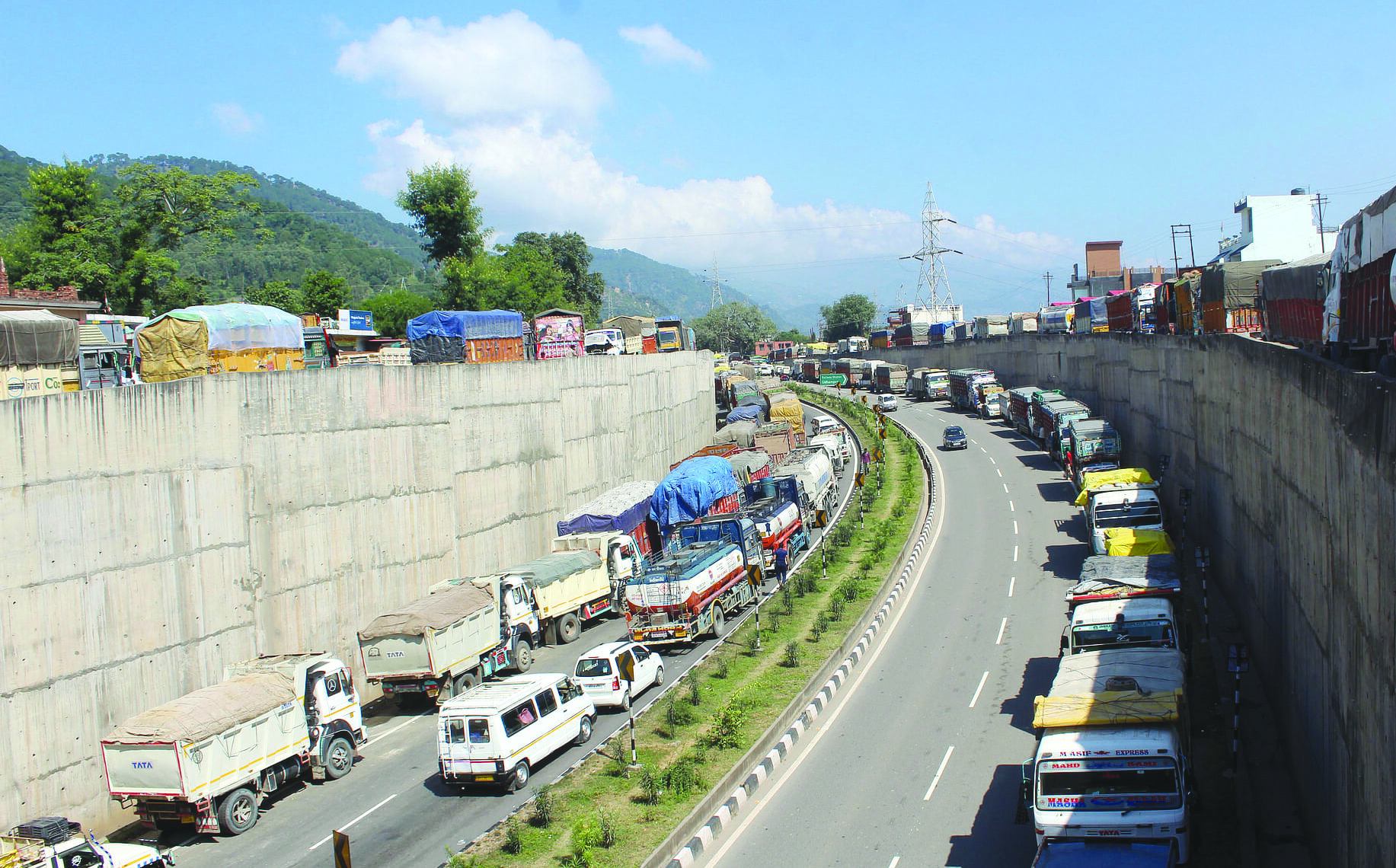
The Kashmir Valley is in the grip of one of the most severe crises in recent years as the Jammu–Srinagar National Highway, its only all-weather road link to the rest of India, remains disrupted by landslides and prolonged closures. Weeks of heavy rains and early snowfall have rendered long stretches impassable, trapping trucks, halting supplies, and crippling the economy at a time when the region can least afford it. From skyrocketing food prices in urban markets to rotting apple harvests in rural orchards, the blockade has touched nearly every household.
The highway, a 270-kilometre stretch winding through the Pir Panjal range, is more than a transport route; it is the artery through which Kashmir receives food, fuel, and medicines, while sending apples, walnuts, and other produce to markets across India. Every day the road stays closed sets off a chain reaction of scarcity and rising costs. Convoys of trucks carrying perishable goods remain stranded for days near Ramban and Banihal, and by the time traffic resumes, vegetables are spoiled, medicines are past their shelf life, and fruit consignments have lost their value. Ordinary Kashmiris feel the impact immediately in household budgets, as food and fuel prices soar and essentials vanish from shops.
In kitchens across the Valley, the price of onions, tomatoes, and leafy greens has nearly doubled since early September. Potatoes, typically a stable option, are also more expensive. Families have begun rationing purchases, and many small eateries have trimmed menus in an attempt to survive the spiraling input costs. Fuel shortages have intensified the crisis. Petrol and diesel supplies run low whenever the road is closed, and rationing at filling stations has become routine. Black-market sales flourish in such conditions, while transporters forced to endure long waits and higher prices transfer the burden to consumers. Cooking gas cylinders are scarce, compelling households to turn to costlier or less sustainable alternatives. Even air travel, which might have provided relief, has become inaccessible for most, with ticket prices soaring to levels that few can afford, leaving the Valley more isolated than ever.
The situation has been particularly dire for the medical sector. Pharmacies are reporting frequent stock-outs of essential medicines, especially those needed for chronic conditions like diabetes, hypertension, and respiratory illnesses. Insulin, antibiotics, dialysis consumables, and pediatric drugs are arriving late or in limited quantities. Hospitals have postponed non-emergency procedures and rationed sterile equipment, while patients and families struggle to locate life-saving medicines or travel long distances in search of treatment. The blockade has thus become not just an economic burden but a health emergency, where the failure of a single road corridor translates into heightened anxiety and risk for thousands of patients.
For the Valley’s horticultural economy, the blockade has struck at the worst possible moment. The autumn harvest, or harud, is the peak period for apple exports, which form the backbone of rural incomes. Trucks filled with apples, pears, and walnuts are stranded on blocked stretches, while in orchards and cold storages, fruit is left to rot. Losses are running into thousands of crores of rupees, as apple boxes that would normally fetch good prices in northern and western Indian markets are being sold for a fraction of their value or not sold at all. Packaging costs have risen sharply, and many farmers, unable to absorb these losses, are being forced into debt. Beyond the immediate financial blow lies the longer-term damage to Kashmir’s reputation as a reliable supplier. Buyers in Delhi and Mumbai demand predictability, and each season of missed deliveries weakens growers’ standing in an already competitive market.
A modest but important intervention has provided some respite. In September, Indian Railways launched a daily parcel train between Budgam and Delhi, equipped with refrigerated vans capable of transporting perishable goods in under twenty-four hours. The service has moved significant quantities of apples and walnuts, shielding some produce from spoilage. Yet its scale is limited. A single train carries only a fraction of the Valley’s daily harvest, and while the service has been welcomed, it cannot compensate for the thousands of truckloads normally dispatched during peak season. Without additional refrigerated wagons, extended routes to other markets, and stronger cold-chain infrastructure, the parcel train remains more a stopgap than a solution.
Government agencies have attempted other temporary measures. Fair-price shops continue to distribute subsidised grains, limited airlifts of essentials have been organised, and hospitals have been urged to manage inventories more tightly. Officials are monitoring markets to prevent hoarding. But these steps, though helpful at the margins, cannot offset the closure of the Valley’s primary supply line. Business groups have voiced deep frustration, accusing the administration of indifference and negligence, while opposition leaders have criticised the slow pace of response and demanded long-term investment in alternative routes. The blockade has thus evolved into a political flashpoint, feeding mistrust between people and institutions and reinforcing a sense of isolation.
The larger problem lies in Kashmir’s structural dependence on a single corridor. Alternative surface routes such as the Mughal Road and Sinthan Top remain closed for much of the year due to snowfall and lack of infrastructure. Air freight is prohibitively expensive for bulk commodities, making it impractical for fruit consignments. The long-delayed Banihal–Katra railway tunnel, which would directly link the Valley to the national rail grid and allow large-scale freight movement year-round, is still under construction. In the meantime, climate change has added urgency to the crisis. Meteorologists warn that precipitation in the western Himalayas is becoming increasingly unpredictable, with heavier storms and more intense snowfall likely in the years ahead. Already this year, unseasonal rains, floods, and hailstorms have battered orchards even before the blockade, compounding losses for farmers.
The lessons of this crisis are clear. The Valley needs a more resilient and diversified system of supply and export. Investment in greenhouse farming and protected cultivation would reduce dependence on imports during the winter months. Expansion of cold-storage facilities and the creation of regional pharmaceutical depots would provide buffers during transport disruptions. Scaling up the railway parcel service, with more refrigerated wagons and multiple routes beyond Delhi, could help insulate horticulture from road blockades. Hospitals and pharmacies require better forecasting and stock management to prevent life-threatening shortages. Above all, there is an urgent need to accelerate infrastructure projects that would provide alternate routes and year-round connectivity, from the Banihal–Katra tunnel to the long-delayed upgrades of the Mughal Road.
Until such measures are realised, Kashmir will remain caught in a recurring cycle of scarcity and inflation each time the highway is blocked. The current blockade has shown how quickly shortages ripple through the social fabric, pushing families into debt, preventing students from reaching schools, forcing daily wage workers off jobs, and leaving small businesses on the verge of collapse. Orchardists, the backbone of the rural economy, are seeing the labour of an entire season wasted in a matter of days.
The Budgam–Delhi parcel train has demonstrated that alternatives are possible when there is focused investment and coordination, but it is no substitute for a comprehensive strategy. For now, Kashmir remains at the mercy of geography, weather, and one fragile road. Each blockade is more than a transport problem; it is a crisis that reaches into every kitchen, every pharmacy, and every orchard. Unless resilience is built into the system, the Valley will continue to lurch from one disruption to the next, bearing costs measured not only in rupees and tonnes of fruit but in the daily hardships and anxieties of its people.
The author is a senior analyst in Kashmir and can be reached at m.hanief@gmail.com
Twitter/ X: @haniefmha


