


Mohammad Hanief
In an era when cultural identities are increasingly shaped by digital algorithms, streaming platforms and global entertainment trends, the quiet work of preserving traditional art forms has become one of the defining challenges of the twenty-first century. Across the world, communities are striving to protect their intangible heritage from the erosive effects of time and changing tastes. In Kashmir, where history and culture have long found expression through poetry, craftsmanship and music, that responsibility rests in significant measure with an extraordinary father-son duo.
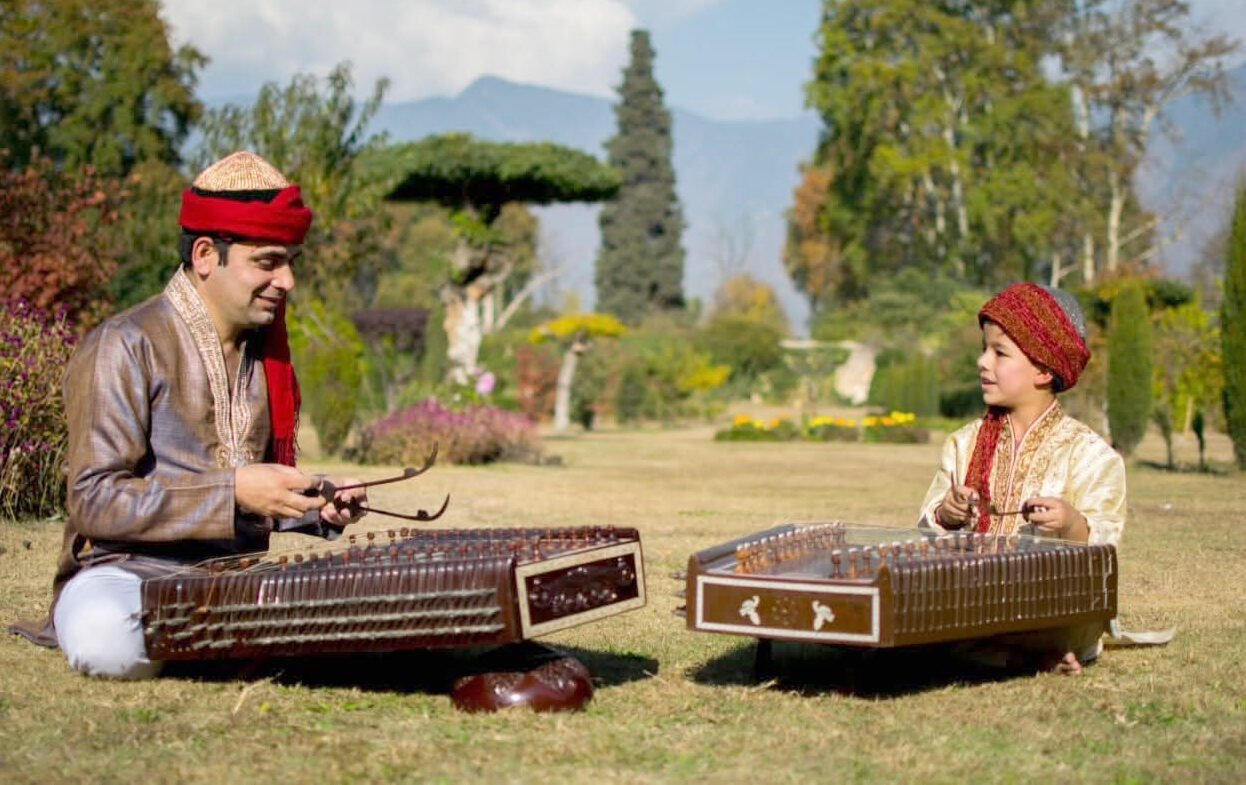
Adil Amin Tibetbaqal and Master Muhammad Abdullah Tibetbaqal are not merely musicians. They are inheritors of a legacy spanning more than a century, custodians of a tradition that has helped shape Kashmir’s cultural consciousness, and living symbols of the region’s enduring relationship with its artistic heritage. Representing the third and fourth generations of the renowned Tibetbaqal musical dynasty, they stand today at the intersection of history and modernity, carrying forward a family tradition that has survived shifting political landscapes, evolving social realities and rapidly changing cultural preferences.
Their story assumes particular relevance in contemporary Jammu and Kashmir. In recent years, the Union Territory has witnessed a renewed emphasis on cultural revival. Heritage festivals, literary gatherings, educational initiatives, and government-supported programmes have sought to reclaim and celebrate Kashmir’s artistic traditions. At the same time, younger generations continue to navigate a world dominated by smartphones, short-form video, and global entertainment. This paradox defines the present cultural moment in Kashmir: a society striving to honour its past while adapting to the demands of the future. It is within this landscape that the Tibetbaqals have emerged as among the Valley’s most influential cultural ambassadors.
The origins of their story lie with Ustaad Muhammad Abdullah Tibetbaqal (1914–1982), the legendary musician remembered across Kashmir as the “King of the Santoor.” Few artists have left as profound an imprint on the region’s cultural identity. At a time when the Santoor remained largely confined to accompaniment within traditional ensembles, he reimagined its possibilities and elevated it into a distinguished solo concert instrument. His mastery of SufiyanaMousiqi—Kashmir’s classical music tradition rooted in Sufi philosophy and shaped by Persian and Central Asian influences—ensured that one of the Valley’s oldest musical forms continued to flourish. In 1972, he became the first artist from Jammu and Kashmir to receive the prestigious SangeetNatakAkademi Award, a watershed moment in the region’s cultural history. His broadcasts on Radio Kashmir reached households across the Valley, and for generations of listeners, the sound of the Santoor became inseparable from his name. More importantly, he established a legacy rooted not merely in performance but in preservation—a legacy that would eventually find expression through his descendants.
Among those descendants, Adil Amin Tibetbaqal has emerged as one of the foremost custodians of the family’s heritage. A Santoor artist, academician, and mentor, Adil has dedicated his professional life to ensuring that the musical traditions of Kashmir remain relevant in an increasingly globalised world. An All India Radio B-High graded artist and gold medallist, he combines performance with rigorous teaching and mentorship.
Through years of classroom instruction and practical guidance, he has introduced countless students to the intricacies of Indian classical Santoor and Kashmiri SufiyanaMousiqi. In doing so, he has assumed a role that extends far beyond that of an educator: he has become a steward of cultural memory. At a time when many traditional art forms struggle to attract younger practitioners, Adil’s sustained efforts have helped nurture a growing appreciation for Kashmiri music within academic institutions and cultural circles. His work reflects a broader understanding that heritage survives not only through archival preservation but through active participation and transmission.
Within the Tibetbaqal household, however, his most significant contribution has been as a father. For Master Muhammad Abdullah Tibetbaqal, Adil is not simply a parent but a mentor whose guidance has shaped the artistic journey of a child prodigy now recognised far beyond the Valley. Their relationship reflects a tradition deeply embedded in Kashmiri society—the transmission of knowledge from one generation to the next through shared experience, patient correction, and daily practice.
Muhammad Abdullah grew up in an environment where music was not an occasional pursuit but a constant presence. The sounds of rehearsals, discussions about ragas and maqams, and stories of his great-grandfather’s contributions formed the backdrop of his childhood. In many ways, his introduction to the Santoor began long before he was old enough to hold the mallets. Family members soon recognised that his connection with the instrument was unusual. Possessing a remarkable sense of rhythm and an instinctive understanding of melody, he demonstrated an aptitude that distinguished him from his peers at an exceptionally young age. Under the careful guidance of his father, his natural talent began to evolve into disciplined artistry.
At the age of five, he made his first public appearance, earning recognition as one of the youngest Santoor performers of note. What followed was a journey that attracted attention from cultural institutions, educational organisations, and media platforms. Today, despite still being a student of Class VIII at Green Valley Educational Institute in Srinagar, Muhammad Abdullah has already established himself as one of Kashmir’s most promising young musicians. His repertoire encompasses Indian classical, Kashmiri classical, SufiyanaMousiqi, folk traditions, and traditional instrumental compositions. His performances have drawn admiration from audiences across generations, and his achievements have been acknowledged by several dignitaries and institutions.
Yet beyond the accolades lies a deeper significance. Muhammad Abdullah represents a generation often described as digitally native—a generation raised amidst unprecedented technological advancement and global connectivity. His commitment to a centuries-old musical tradition challenges assumptions about the declining relevance of classical arts among young people. In many ways, his journey offers a compelling response to one of the central questions confronting contemporary societies: Can tradition survive in the digital age?
The answer, it would seem, lies in the relationship between father and son. Together, Adil Amin Tibetbaqal and Muhammad Abdullah Tibetbaqal embody two complementary dimensions of cultural preservation. One represents experience, scholarship, and mentorship; the other symbolises continuity, possibility, and the future. Their partnership illustrates that heritage is not inherited automatically. It must be nurtured, practised, and consciously passed from one generation to the next.
As Jammu and Kashmir continues to invest in cultural preservation, the story of the Tibetbaqals serves as a timely reminder that institutions alone cannot sustain heritage. Ultimately, it is preserved through individuals willing to dedicate their lives to its survival. For Adil Amin Tibetbaqal, that dedication has manifested through education, performance, and fatherhood. For Muhammad Abdullah Tibetbaqal, it is expressed through youthful passion and artistic promise.
Together, they represent more than four generations of musical excellence. They represent the enduring spirit of Kashmir itself. And as the notes of the Santoor continue to echo through classrooms, concert halls, and cultural gatherings, they carry with them a simple but profound truth: traditions do not disappear when they are cherished. They endure, finding new life in every generation willing to listen, learn, and carry them forward.
The author is a senior analyst and environmentalist. Feedback can be sent to
m.hanief@gmail.com. Twitter/X: @haniefmha


