


Mohammad Hanief
Education is often regarded as the foundation of social transformation, yet for many schoolchildren, the journey towards education remains difficult. Across India, students continue to face physical, economic, academic and social challenges, while a new concern has emerged with equal urgency: growing dependence on smartphones and digital entertainment.
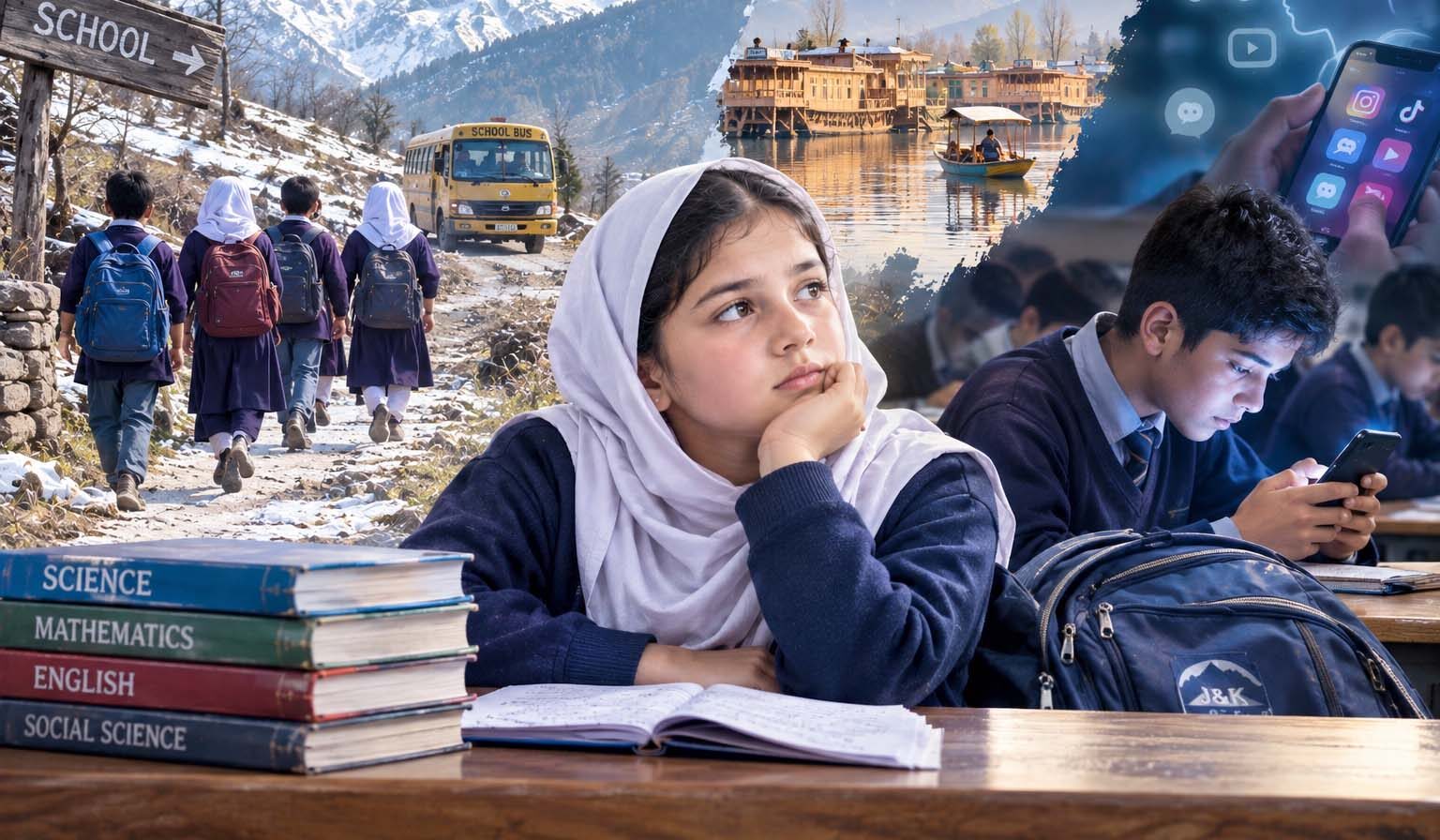
The child of today is caught between the traditional world of classrooms, books and teachers and a digital world of instant information, online games, social media and short videos. The challenge is to ensure that technology supports education rather than weakening concentration, while schools become more accessible, inclusive and child-centred.
For many children, particularly those living in rural, remote and economically weaker communities, reaching school can itself be a daily hardship. Long distances, inadequate transport, difficult terrain, poor roads and seasonal disruptions can affect attendance and make the journey exhausting.
Financially disadvantaged families may also struggle to meet the costs of books, uniforms, stationery, transportation and other educational requirements. Although access to schooling has improved considerably, accessibility alone cannot guarantee a comfortable and meaningful learning experience.
The school environment is equally important. Inadequate classrooms, limited libraries, poorly equipped laboratories, insufficient sanitation facilities and shortages of learning resources can restrict children’s educational opportunities. A school should not merely be a building where lessons are delivered. It should provide an environment in which children can read, experiment, communicate, participate in sports, explore their interests and develop confidence. The quality of infrastructure and the availability of supportive learning spaces directly influence how children experience education.
Academic pressure has added another layer to these difficulties. Increasing competition, examination expectations and comparison among students can make education excessively marks-oriented. When children begin to associate learning mainly with grades, curiosity and creativity may gradually decline. Fear of failure can become stronger than the desire to understand. The education system must therefore recognise children’s emotional and developmental needs alongside academic achievement and create an environment where mistakes are treated as opportunities for learning.
At the same time, smartphones have transformed childhood. Digital technology has undeniable educational value. Students can access digital books, lectures, educational applications, language resources and information from around the world. Online platforms can extend learning beyond the classroom and provide valuable resources to students and teachers. However, the same device that opens a window to knowledge can also become a powerful source of distraction.
Children can move within seconds from educational content to online games, social media, entertainment and short-form videos. Digital platforms are designed to provide continuous stimulation, while serious study demands patience, concentration and sustained attention. When excessive screen use becomes part of everyday life, children may spend less time reading, playing outdoors, interacting with family members and engaging in creative activities. It can also disturb sleep, physical activity, concentration and face-to-face communication.
The concern should not be reduced to the simple question of how many hours a child spends on a phone. The more important issue is whether smartphone use begins to control daily habits. Technology should remain a tool in a child’s hands rather than becoming the centre of childhood. Completely removing digital devices is neither practical nor desirable in a modern educational environment. What children need is digital discipline: the ability to use technology productively while recognising when entertainment has become excessive.
Parents and teachers have a shared responsibility in developing this balance. Children need consistent routines that include study, adequate sleep, outdoor activity, reading and family interaction. Parents also need to model responsible digital behaviour because children often imitate what they observe. Schools can support families by promoting digital well-being, online safety, awareness of cyberbullying, misinformation and responsible use of social media.
This changing environment makes the National Education Policy 2020 particularly relevant. NEP 2020 seeks to move Indian education away from excessive rote learning towards conceptual understanding, critical thinking, creativity, problem-solving and holistic development. Its emphasis on foundational literacy and numeracy, experiential learning, vocational education, multilingualism, arts, sports and multidisciplinary learning reflects the need to prepare children not only for examinations but also for life.
The focus on foundational literacy and numeracy is especially important. A child who struggles to read with understanding, write effectively or perform basic mathematical operations in the early years can face difficulties throughout later schooling.
Strengthening these foundations can reduce learning gaps and improve educational outcomes. Recent assessments have shown encouraging improvement in foundational learning, demonstrating that targeted interventions can produce meaningful results. However, progress must reach children in schools where resources and support remain limited.
The success of NEP 2020 will ultimately depend on implementation at the grassroots level. Educational reform cannot remain confined to policy documents. It must be visible in the everyday experience of students. Teachers need continuous professional development, schools require adequate infrastructure, and children need access to libraries, laboratories, sports facilities, digital resources and supportive learning environments.
Teachers will remain central to this transformation. Digital platforms and artificial intelligence can provide information and assist learning, but teachers offer human understanding, encouragement and personal guidance. A teacher can recognise when a child is struggling, understand individual differences and build confidence. Technology should therefore complement teachers rather than replace the human relationship that remains at the heart of education.
The future of schooling also requires renewed attention to reading, sports and creative activities. Libraries, storytelling, debates, writing, cultural programmes and outdoor learning can strengthen concentration, imagination, communication and social skills. In an age dominated by screens, these activities are not outdated; they are increasingly necessary. Children need opportunities to experience the world directly rather than encountering everything through a digital device.
Schools also need sensible and age-appropriate approaches to smartphone use. Complete prohibition may not always be practical because digital resources are becoming part of education. Unrestricted access, however, can undermine classroom concentration. Clear rules should distinguish educational use from recreational consumption while teaching students self-control and responsible digital citizenship.
The way forward requires simultaneous attention to traditional educational hardships and emerging digital challenges. Improving school infrastructure, transportation, libraries, laboratories and teacher support must continue, particularly in underserved communities. Foundational learning should remain a priority, while counselling and student well-being should become integral parts of schooling. Digital resources should be expanded responsibly, with equal attention to digital literacy and digital discipline.
The educational journey of a child should not become a competition between a textbook and a smartphone. Both have a place in modern education, but their roles must remain clear. A smartphone can provide information, while a book can encourage deeper reading. Technology can connect children to the world, while teachers and real-life experiences help them understand it.
India is at an important point in its educational journey. NEP 2020 offers an opportunity to build an education system that is flexible, inclusive, experiential and child-centred. Yet its success will be judged by whether children can attend school with dignity, learn without excessive pressure, remain physically active, develop healthy relationships, think independently and use technology responsibly.
The school of the future must therefore be technologically equipped but deeply human. It should teach children how to use digital tools without becoming dependent on them, how to compete without losing compassion and how to succeed without sacrificing curiosity. Above all, education must preserve the joy of learning.
The ultimate purpose of schooling is not merely to prepare children for examinations but to prepare them for life. In the digital age, that means ensuring that every child has the opportunity to learn, think, create, communicate and grow while keeping the smartphone in its proper place: as a useful tool, not as the force that shapes childhood.
(The author is a senior analyst and environmentalist. Feedback can be sent to m.hanief@gmail.com. Twitter/X: @haniefmha)


