


Mohammad Hanief
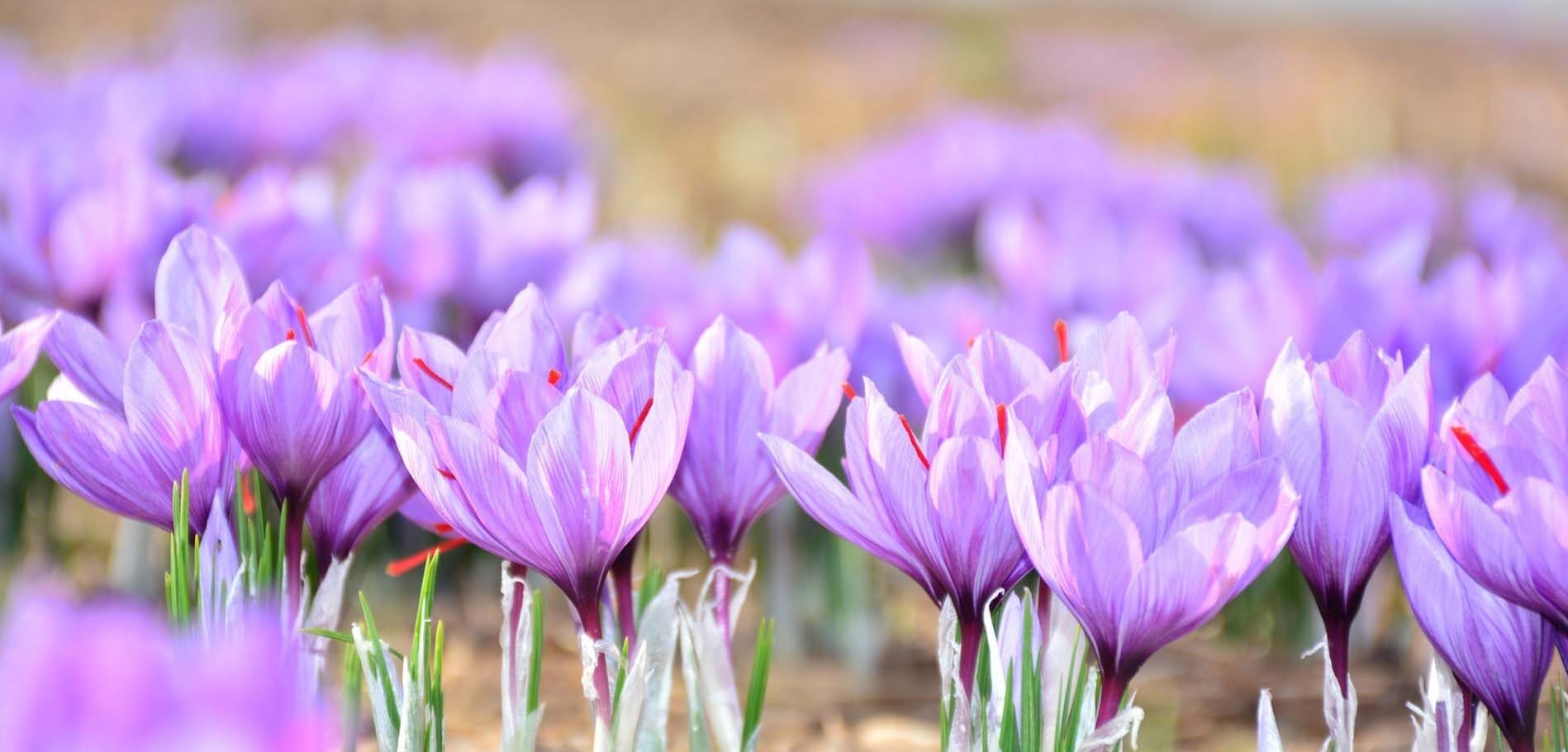
Saffron is more than a precious spice in Jammu and Kashmir; it is a symbol of heritage, identity and the enduring relationship between people and the land. The purple flowers that bloom across the saffron fields of Pampore represent generations of agricultural knowledge, the hard work of farming families and a tradition that has earned Kashmir recognition far beyond the Himalayan region. Often called red gold, saffron remains one of the most valuable crops cultivated in the Union Territory, offering considerable economic potential despite the challenges facing its production.
Today, Kashmir’s saffron industry is passing through a critical phase. Climate variability, inadequate irrigation, rising cultivation costs, pressure on agricultural land and marketing difficulties have made the future of saffron farming a matter of growing concern. At the same time, Ladakh is exploring the possibility of cultivating this high-value crop under its distinctive cold-desert conditions. The emerging initiative offers a new agricultural prospect, provided it is supported by scientific research, responsible water management and sustained institutional assistance.
The developments in Kashmir and Ladakh underline a wider need to strengthen traditional agriculture, diversify rural livelihoods and protect the natural resources on which Himalayan communities depend.
Pampore, in south Kashmir’s Pulwama district, is widely recognised as the centre of saffron cultivation. The crop is also grown in other suitable parts of the region, including areas of Budgam and Kishtwar. Locally known as “kong”, saffron occupies a distinctive place in Kashmiri culture, cuisine and hospitality.
Its delicate crimson stigmas are valued for their colour, aroma and flavour. Saffron is used in traditional dishes, beverages, confectionery and various commercial products. Its exceptionally high value relative to its weight is linked to the labour-intensive process of harvesting flowers, separating the stigmas and drying them under carefully controlled conditions.
For generations, saffron cultivation has provided income to farming families and contributed to the rural economy. Yet its importance cannot be measured by its market price alone. The crop represents traditional knowledge, seasonal agricultural practices and a cultural landscape that has become inseparable from Kashmir’s identity.
The Geographical Indication tag granted to Kashmir saffron in 2020 further strengthened its distinct identity. This recognition provides an important foundation for protecting authentic produce, improving consumer confidence and ensuring that Kashmir’s reputation is not undermined by adulteration or misleading labelling.
Kashmir’s saffron sector has received renewed attention through government-supported rejuvenation programmes, irrigation development and efforts to improve marketing. Officially reported production figures indicate that output reached approximately 23.53 metric tonnes in 2023–24 before declining to around 19.58 metric tonnes in 2024–25.
These fluctuations demonstrate that production remains sensitive to seasonal conditions and the effectiveness of cultivation practices. While rejuvenation programmes have helped improve selected saffron fields, sustainable progress requires more than restoring land or distributing planting material. Farmers need reliable irrigation, healthy corms, technical guidance and a market that rewards quality.
Climate variability has become an important concern for saffron growers. Irregular rainfall, prolonged dry spells and changing temperature patterns can affect the crop’s development and flowering. Since saffron depends on suitable moisture conditions at critical stages, water scarcity can significantly undermine productivity.
The expansion of settlements and commercial activities has also placed pressure on agricultural land in parts of Kashmir. Protecting traditional saffron fields is essential not only for safeguarding farmers’ incomes but also for preserving the agricultural heritage of the region.
Another persistent difficulty is the gap between the premium reputation of Kashmiri saffron and the returns received by individual growers. High cultivation costs, dependence on intermediaries, limited processing facilities and the risks of adulteration can reduce farmers’ earnings. Strengthening quality testing, transparent trading, modern packaging and direct links with buyers is therefore essential.
The future of Kashmir’s saffron industry depends on making cultivation more productive, climate-resilient and financially rewarding.First, irrigation infrastructure must be strengthened and maintained. Farmers need dependable access to water at appropriate stages of cultivation, particularly when rainfall is inadequate. Water-efficient irrigation methods, soil-moisture monitoring and locally suitable cultivation practices can help improve the use of available resources.
Second, agricultural research must be translated into practical support at the farm level. Regular soil testing, healthy planting material, improved field management and scientific harvesting and drying techniques can help protect both yield and quality.
Third, the marketing system requires greater transparency. The India International Kashmir Saffron Trading Centre at Pampore offers an important platform for organised trade. Stronger quality certification, traceability, digital marketing and direct connections with buyers could help farmers obtain better prices.
Finally, farmers’ cooperatives and producer organisations should be encouraged to participate in processing, packaging and branding. Greater local involvement in the value chain would allow farming communities to capture a larger share of the economic benefits generated by this valuable crop.
Ladakh’s New Saffron Experiment
While Kashmir works to strengthen its traditional industry, Ladakh has begun exploring saffron cultivation as a possible avenue for agricultural diversification.In October 2026, a pilot saffron plantation was initiated at SpitukPharka in Leh. The project reportedly involved approximately 90,000 saffron corms, weighing around 800 kilograms, planted across nearly 4,000 square metres of restored land under Project Him Sarovar.
The initiative aims to assess whether saffron can grow successfully in Ladakh’s high-altitude, cold-desert environment. The region receives limited rainfall, experiences considerable temperature variations and has a short agricultural season. These conditions make the experiment particularly significant, but they also require careful scientific evaluation.
The pilot plantation should be viewed as an opportunity to generate evidence rather than as proof that saffron can immediately become a major commercial crop in Ladakh. Its performance will depend on soil conditions, drainage, seasonal temperatures, water availability and the ability of the plants to flower and produce quality stigmas.
If the pilot project proves successful, saffron could offer several potential advantages for Ladakh’s rural economy.Saffron could provide an additional source of income for farmers in suitable locations, complementing existing crops rather than replacing those essential for local food security.Cultivation, flower harvesting, stigma separation, drying, grading and packaging could generate work for local residents. Related activities may also create opportunities for small businesses and agricultural entrepreneurs.
Women’s self-help groups could participate in processing, packaging, branding and marketing. Appropriate training, access to credit and reliable market connections would be necessary to turn these activities into sustainable sources of income.Where soil and water conditions permit, saffron may help bring selected underutilised plots into productive use. However, land restoration must be guided by scientific assessment, and not every barren area will be suitable for cultivation.
Kashmir and Ladakh possess different agricultural environments, but their experiences could complement one another. Kashmir offers generations of knowledge in saffron cultivation, harvesting, processing and marketing. Ladakh provides an opportunity to examine the crop’s adaptability under different Himalayan conditions.
With effective government support, farmer participation, improved technology and responsible resource management, Kashmir can strengthen its position in the saffron industry while Ladakh explores a promising new agricultural opportunity. The ultimate measure of success will not simply be the expansion of saffron fields, but the creation of sustainable livelihoods, stronger rural economies and a more resilient agricultural future for the Himalayan region.
The author is a senior analyst and environmentalist. Feedback can be sent to m.hanief@gmail.com. Twitter/X: @haniefmha


