


Dr. Reyaz Ahmad
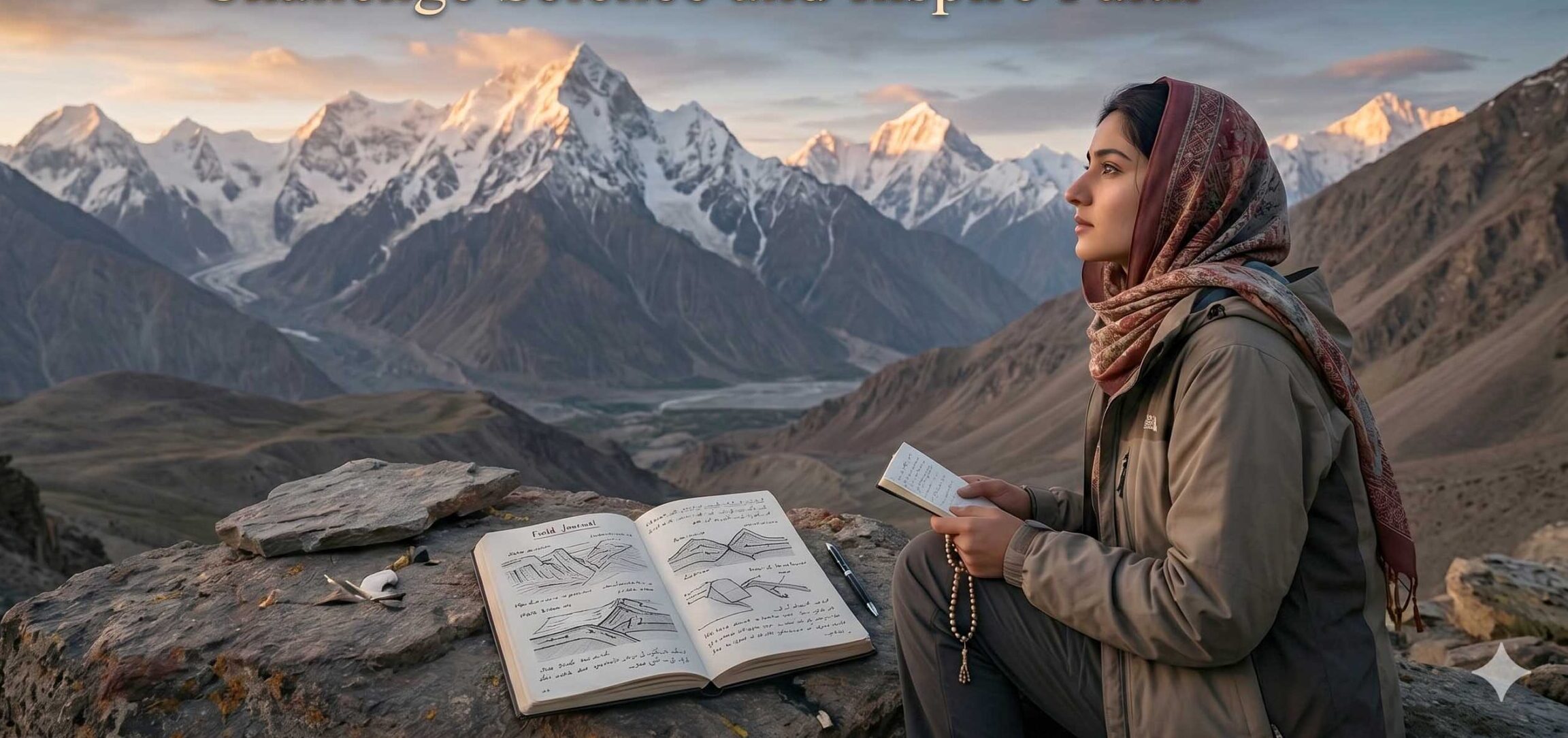
Mountains have always stood before humanity as silent giants—majestic, mysterious, powerful, and deeply symbolic. Across cultures and languages, they appear in proverbs, poetry, moral teachings, and religious texts as symbols of strength, patience, endurance, and divine power. We speak of “standing like a mountain” when we refer to firmness, and we describe a great difficulty as “a mountain to climb.” This shows that mountains are not merely physical structures of rock and soil; they are deeply rooted in human imagination, faith, and philosophy.
The Qur’an also invites human beings to reflect upon mountains as remarkable signs of creation. In several verses, mountains are mentioned in connection with the stability, beauty, and balance of the earth. For believers, these references are not only descriptions of nature but invitations to think, observe, and recognize the wisdom behind creation. At the same time, modern science studies mountains through geology, climate science, hydrology, ecology, and environmental research. This creates a fascinating meeting point between faith and scientific inquiry: faith inspires wonder, while science investigates mechanisms.
Yet an important question remains: if mountains are so visible, so culturally important, and so frequently mentioned in religious and literary traditions, why do we still not fully understand them scientifically?
The answer is not that mountains have been ignored by science. They have been studied for a long time. However, they remain among the most difficult natural systems to explore completely. A mountain is not just a raised piece of land. It is a complex living system of rocks, glaciers, rivers, forests, minerals, animals, human communities, weather patterns, landslides, earthquakes, and underground movements. To understand one mountain range properly, scientists need knowledge from geology, physics, geography, climatology, biology, engineering, and social sciences.
One major challenge is access. High mountain regions are often dangerous and difficult to reach. Extreme cold, low oxygen, avalanches, landslides, glaciers, sudden storms, and steep slopes make field research risky and expensive. Unlike cities, laboratories, or plains, mountains do not easily allow researchers to install instruments, conduct repeated observations, or move equipment. Even today, many mountain areas remain physically difficult to study for long periods.
Another challenge is political and geographical sensitivity. Many of the world’s major mountain systems lie across national borders or sensitive regions. The Himalayas, Karakoram, Hindu Kush, Alps, Andes, and Caucasus are not only geographical formations but also strategic zones. Border restrictions, military presence, limited infrastructure, and difficult travel conditions often slow scientific research. As a result, some regions remain less explored than their importance demands.
Mountains are also scientifically complex because their surface does not reveal everything about their inner structure. Satellites can observe snow cover, glaciers, forest change, and landslides from above, but the deeper interior of mountains—fault lines, rock stress, underground water, and crustal movement—requires advanced geophysical methods. Even with modern instruments, the inner life of mountains remains difficult to read fully.
Modern geology has already revealed much about how mountains are formed. Many mountain ranges are created by the movement of tectonic plates. When plates collide, the earth’s crust folds, breaks, rises, and forms massive ranges. The Himalayas, for example, are linked to the collision between the Indian and Eurasian plates. Other mountains are formed by volcanic activity, faulting, erosion, and uplift. Science also explains that many mountains have deep crustal “roots,” somewhat like the hidden part of an iceberg beneath the water. This gives us a deeper appreciation of the mountain as something both visible and hidden.
However, this scientific understanding must be handled carefully when connected with religious interpretation. The Qur’an encourages reflection on mountains as signs of divine wisdom, but it should not be reduced to a textbook of geology. Its purpose is guidance, reflection, and moral awakening. Science, on the other hand, explains physical processes. The most balanced approach is to see the Qur’an as inviting human beings to observe nature with humility, while science provides tools to study how nature functions.
In the present age, mountains have become even more important because of climate change and environmental risk. Today, scientists describe mountains as the world’s “water towers.” Snow, glaciers, and mountain streams provide water to billions of people. Rivers born in mountain regions support agriculture, drinking water, hydropower, biodiversity, and entire civilizations. The Hindu Kush Himalayan region, for instance, feeds major river systems in Asia and affects the lives of nearly two billion people.
This is why modern mountain research is no longer limited to rocks and peaks. Scientists are now deeply concerned with glacier melting, glacial lake outburst floods, landslides, earthquakes, permafrost thawing, biodiversity loss, and the survival of mountain communities. When glaciers shrink, future water supply becomes uncertain. When frozen ground melts, slopes become unstable. When mountain forests disappear, floods and landslides become more destructive. When mountain communities suffer, migration, poverty, and cultural loss follow.
Technology has certainly improved our ability to study mountains. Satellites, remote sensing, drones, climate models, GPS monitoring, and seismic instruments now allow scientists to observe changes that were once invisible. NASA and other research agencies are studying high mountain regions to understand snow, glaciers, rainfall, water flow, and natural hazards. Yet technology has not removed all uncertainty. Mountains remain dynamic, changing, and unpredictable.
This is why the title “The Silent Giants” is so meaningful. Mountains appear silent, but they are not inactive. They move slowly, store water, influence climate, shape rivers, support biodiversity, and sometimes release destructive energy through earthquakes, landslides, and floods. Their silence should not be mistaken for stillness. They are among the most powerful natural systems on earth.
For human civilization, mountains carry a double message. Spiritually, they remind us of humility, patience, and the greatness of creation. Scientifically, they remind us that nature is far more complex than what appears on the surface. They challenge our arrogance and invite both faith and knowledge. They teach us that wonder and investigation are not enemies; rather, they can strengthen each other when approached with sincerity and balance.
The real issue, therefore, is not whether mountains have been explored scientifically. They have. The issue is that they have not been fully understood because they are among the most complex, dangerous, and vital systems on the planet. Their cultural and religious importance has been recognized for centuries, but their environmental and scientific importance is becoming more urgent in our own time.
For centuries, mountains have taught humanity through silence, height, and majesty. Today, science is discovering that these silent giants are not passive stones standing at the edge of human life. They are active guardians of water, climate, biodiversity, and survival. They continue to inspire faith, challenge science, and remind humanity that the more we know about nature, the humbler we must become.
Author Can Be Mailed At reyaz56@gmail.com


