


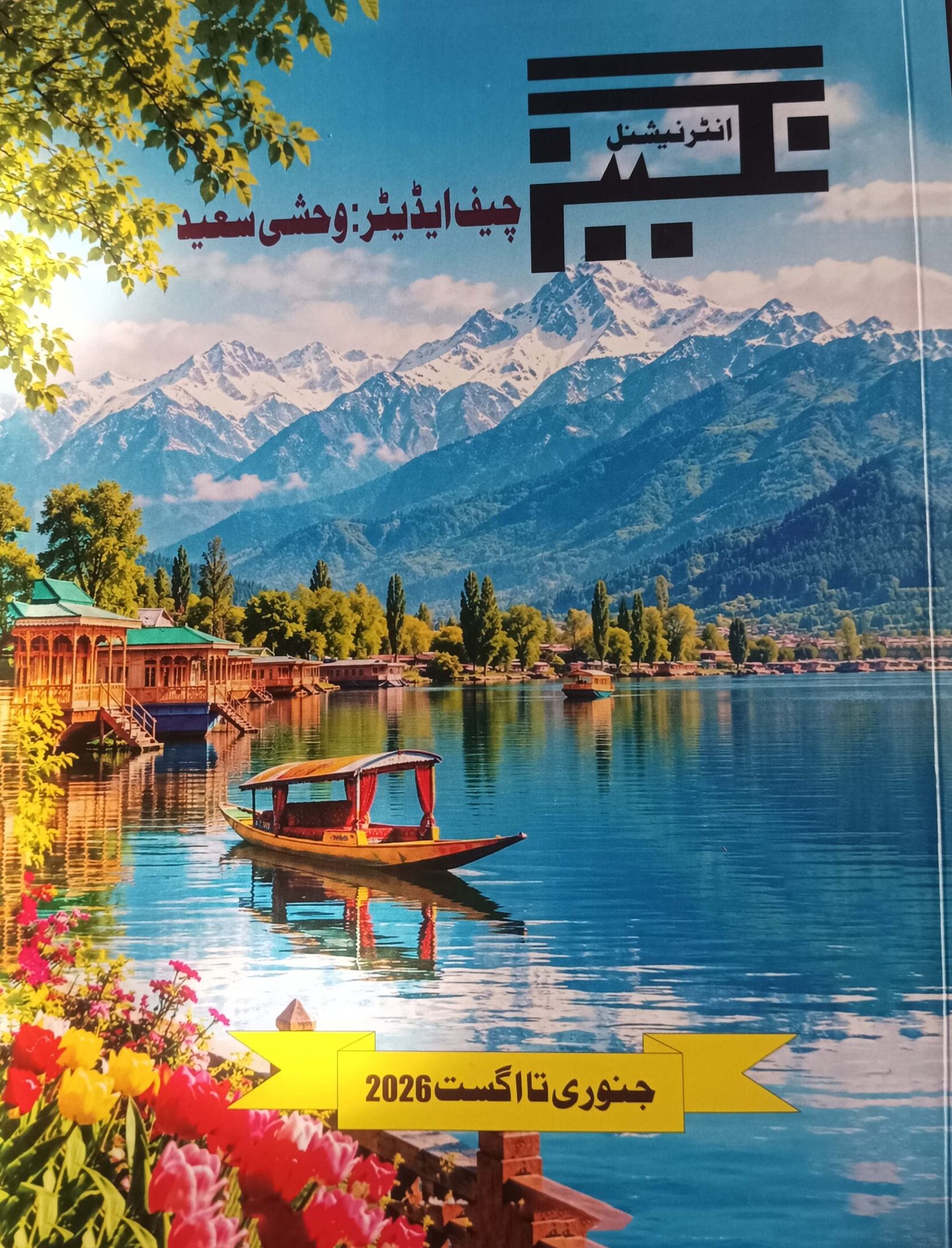
Among the various prestigious and high-quality literary magazines and journals of the country that are tirelessly working for the promotion and preservation of Urdu language and literature, the monthly Nagina International occupies a place of considerable respect and distinction. Published under the editorship of the revered Noor Shah Sahib and the sincere, literature-loving Wahshi Syed Sahib, this magazine is not only counted among the country’s reputable literary journals but also plays a commendable role in encouraging emerging writers, poets and literary enthusiasts by publishing their contributions alongside those of established literary personalities. Wehshi Sayed Sahib not only shoulders the editorial responsibilities of the magazine but also organises splendid literary gatherings at his renowned Hotel Shahenshah Palace, situated near the picturesque Dal Lake, where new issues of the magazine are formally released. What deserves special appreciation is that he personally bears all the expenses of these functions, which speaks volumes about his generosity, passion for literature and unwavering commitment to Urdu language and literature. The latest issue of the magazine was also formally released last month during a dignified literary gathering held at the same hotel, attended by a galaxy of distinguished writers, poets and literary personalities. Comprising 184 pages, the issue features an exceptionally attractive and aesthetically pleasing cover. Its editorial pays a heartfelt tribute to the renowned literary figure Varinder Patwari, who departed from this world in April this year. It also carries an important message encouraging the younger generation to stay away from the menace of drug addiction and instead develop an interest in the enriching world of literature. The opening pages feature Hamd and Naat compositions by Ashraf Adil, Ali Shahid Dilkash’s poem Tajalliyat-e-Ramadan, and an impressive ghazal by Rafiq Raz. The issue also includes an introduction to Varinder Patwari, an account of his literary publications and his short-short story Jumood (Stagnation). The insightful and thought-provoking personal essay Oonch Neech (High and Low), written by renowned educationist and former Head of the Department of Urdu, University of Kashmir, Professor Mohammad Zaman Azurdah, stands out as one of the finest contributions to the magazine’s section devoted to personal essays. Three other remarkable essays—Engineer Shafi Ahmad’s Dil (Heart), S. Mashooq Ahmad’s Duniya Gol Hai (The World Is Round), and Zanfar Khokhar’s Women Empowerment—have also been included. Together, these four engaging and intellectually stimulating pieces considerably enhance the literary value of the issue and offer readers an excellent opportunity to appreciate quality essay writing. Following the personal essays, the magazine presents a rich poetry section featuring compositions by several distinguished poets. Among the notable contributors are Rafiq Raz, Saifi Sironji, Ashraf Adil, Parvez Manoos, Shabnam Ashai, Shameem Akhtar, Mushtaq Mehdi, Hashir Afnan, Dr Gulzar Wani and Sheikh Gulzar, among others. By incorporating prose poems, free verse, ghazals and qasidas, this section presents a beautiful bouquet of poetic genres. It not only enhances the literary appeal of the magazine but also acquaints readers with the distinctive styles, intellectual perspectives and creative abilities of different poets. The articles section opens with Professor Sheikh Aqeel Ahmad’s Parvez Muzaffar Ki Nazm Nigari (The Poetic Art of Parvez Muzaffar). According to the writer, Parvez Muzaffar resides in Birmingham and has been serving Urdu literature through his poetry for a considerable period. The article highlights how Muzaffar’s poems artistically portray the fragmented identity of contemporary humanity, the restlessness of immigrants and the hidden brutality within an apparently civilised world. Birmingham is home to people belonging to diverse nationalities, cultures and ethnic backgrounds, and its multicultural environment is distinctly reflected in his poetry. The second contribution in this section is a review by Shariq Adeel of Dr Premi Romani’s book Iqbal Aur Jadeed Shairi (Iqbal and Modern Poetry). The review reveals that the book comprises five chapters. It is particularly valuable for readers interested in Iqbal studies and those seeking a deeper understanding of his philosophical thought and poetic craftsmanship. Shahnawaz Nazir’s article Lafzon Ka Masiha: Wahshi Sayed (The Messiah of Words: Wahshi Saeed) is another noteworthy inclusion. According to the writer, Wahshi Sayed’s writings are characterised by an absence of unnecessary noise, exaggerated claims and pretence. Anwar Afaqi’s informative and engaging article Qurratulain Haider Ke Navalon Mein Manzar Nigari Aur Uski Ahmiyat (Description of Scenes in Qurratulain Haider’s Novels and Its Significance) is another outstanding feature of this issue. The writer beautifully highlights the artistic and literary qualities of Qurratulain Haider’s novels, describing her descriptive technique as distinctive and unparalleled. Through a detailed examination of several of her novels, he discusses the significance of scenic description, artistic refinement and aesthetic dimensions in her fictional world. Saleem Salik’s article Qudrat Ka Waqfa-e-Rehmat (Nature’s Interval of Mercy) is a contribution of a different nature. The writer skilfully presents the Interglacial Period as a genuine interval of nature’s mercy—a period during which ice retreats and life advances. By presenting scientific facts in an engaging literary style, he has made the article informative, interesting and thought-provoking. Dr Sabrina Javed’s detailed and informative article The Present Status of Children’s Literature in Jammu and Kashmir is another significant contribution to the issue. While examining the prevailing condition of children’s literature in the region, the writer draws attention to the limited number of authors engaged in writing for children. According to her, Hameeda Shah Akhtar, Parvez Manoos and Dr Neelofar Naz Nahvi are among the few noteworthy literary figures who have contributed to this important field. The fiction section contains sixteen short stories by established and accomplished fiction writers from across the country. Soch Ka Lamha (A Moment of Reflection), the opening story of this section, deeply moves the reader. Through an effective portrayal of social realities, the writer highlights the seemingly insurmountable wall separating the rich and the poor, exposing the bitter realities of class discrimination and social inequality. The issue also features an Urdu translation by Bashir Athar of the Kashmiri short story Akbar Tanga Wol, originally written by renowned poet and fiction writer Bashir Dada.
The story artistically addresses several social issues. Through its characters, the writer presents a sharp satire on social inequalities, human behaviour and societal contradictions, which remains evident throughout the narrative. Noor, written by the Valley’s renowned physician and fiction writer Dr Nazir Mushtaq, is among the most distinctive and impressive stories in this section. Besides providing readers with valuable insights into a complex medical condition like Alzheimer’s disease, the story introduces them to an unusual, fascinating and touching tale of love. By skilfully combining medical realities with human emotions, the author has made this literary creation particularly engaging and meaningful. Dr Riyaz Tauheedi’s short story Nasheeli Hawa (Intoxicating Wind) highlights one of the most serious social problems of contemporary times. Young people trapped in drug addiction not only destroy their own lives but also become a source of suffering for society at large. Through this story, the writer draws attention to a disturbing reality confronting our society. Raja Yusuf’s short story Sila (Recompense) addresses another serious contemporary social concern. In today’s relentless pursuit of wealth and prosperity, parents often send their children abroad for higher education and better employment opportunities. However, when these very children begin to neglect their parents completely, the emotional suffering becomes almost unbearable. In such circumstances, parents may eventually feel compelled to give away or dedicate their lifelong savings and property rather than leave them to their indifferent children. Akhtar Meraj’s short story Aangan (Courtyard) presents a touching narrative of love, attachment and devotion towards one’s native soil. The writer beautifully explores the deep emotional relationship between human beings and their homeland. Zafar Khokhar’s short-short story Insaaf (Justice) offers a sharp satire on the bitter realities of contemporary society. The writer effectively exposes the unfortunate tendency whereby demanding one’s legitimate rights and seeking justice are sometimes treated as acts contrary to peace, while those raising their voices against injustice are themselves branded as troublemakers. The issue also contains critical reviews and introductory articles contributed by Rayees Ahmad Kumar, Zaheer Anwar, Rehana Shajar and Suhail Salim.
The distinguished fiction writer Noor Shah Sahib has presented a comprehensive, detailed and well-written account of various literary events held between November 2025 and June 2026. These programmes, organised under the auspices of different literary organisations, have been documented with remarkable care and attention to detail. This record of literary activities constitutes another important feature of the magazine.
Under the heading Kahan Gaye Yeh Log (Where Have These People Gone?), Noor Shah Sahib has contributed a detailed and informative article on Shoreeda Kashmiri, a multifaceted personality from Shopian district who enjoys recognition as a distinguished poet throughout the Indian subcontinent. He has also written a comprehensive article on Munshi Mohammad Din Fauq, offering an extensive discussion of his life, scholarly contributions and literary achievements. Under the section titled Qand-e-Mukarrar (Once Again, with Pleasure), an excellent article by Dr Johar Quddusi on Rasa Javedani’s poetry collection Nairang-e-Ghazal has also been included. The article attempts a comprehensive evaluation of Rasa Javedani’s poetic qualities, artistic excellence and literary stature. Overall, the latest issue of Nagina International is a valuable contribution from both scholarly and literary perspectives. It certainly deserves to be read by every discerning reader, particularly those who cherish Urdu language and literature and possess a keen interest in quality literary creations. The issue not only satisfies the literary tastes of its readers but also introduces them to the diverse dimensions of Urdu literature, reaffirming the magazine’s distinguished position in the contemporary Urdu literary landscape.
Author Can Be Mailed At rayeeskumar31@gmail.com


