


Roads blocked, rivers surging past danger levels
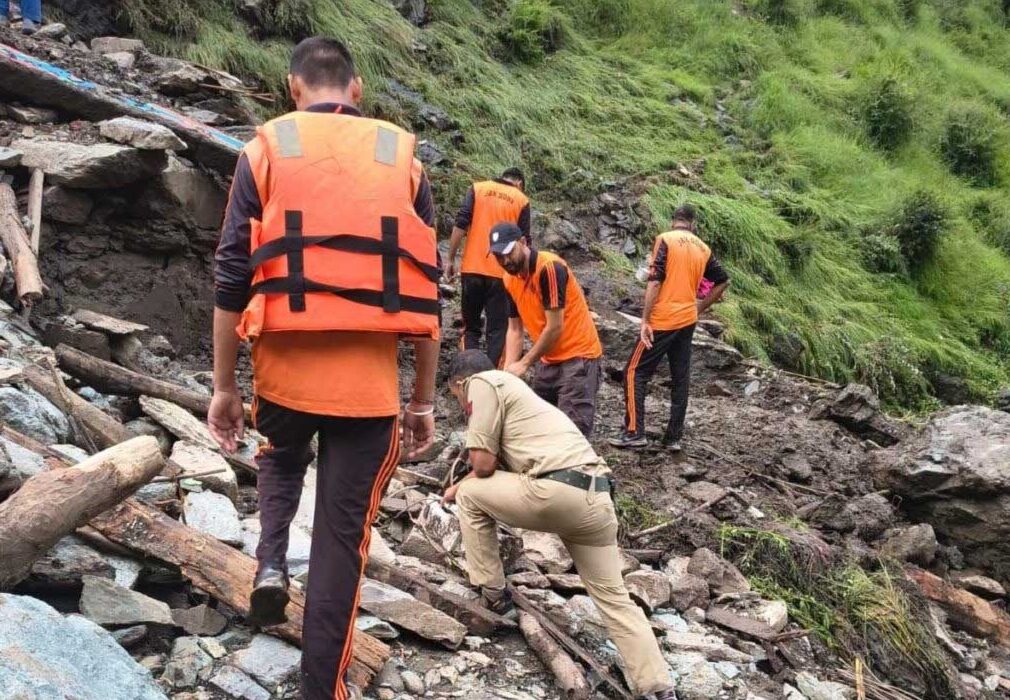
Jammu/Srinagar: At least five people were killed, several major roads were closed, rivers and nallahs swelled to dangerous levels, and widespread damage was reported across Jammu and Kashmir on Wednesday as incessant rainfall triggered flash floods, landslides and waterlogging, prompting authorities to issue fresh advisories and intensify rescue operations.
According to details obtained by the news agency—Kashmir News Observer (KNO), two people were killed after a Tempo Traveller was hit by falling stones at Gangroo in Ramban district, while three others lost their lives after being swept away by floodwaters in separate incidents in Bandipora and Budgam districts, officials said.
In Bandipora, the bodies of 14-year-old Amir Khatana, son of late Mehboob Khatana and his mother were recovered from Guzarbal nallah after they were swept away by flooded Nallah while trying to retrieve firewood being carried downstream by the swollen nallah.
In Budgam district, a man identified as Shabir Ahmad Poswal of Drang died after being swept away by a flooded nallah. His body was later retrieved by rescue teams.
Heavy rainfall also forced the temporary closure of the Batote-Kishtwar National Highway (NH-244), while traffic movement remained affected at several vulnerable stretches due to landslides and shooting stones, officials said.
Meanwhile, a massive search operation entered the fourth day in Rajouri district to trace Abdul Ghani, a Jal Shakti Department employee who went missing after floodwaters washed away a pumping station at Plangarh village in Thanamandi. Teams of the SDRF, NDRF, police and the Army are participating in the rescue operation.
Deputy Commissioner (DC) Rajouri Abhishek Sharma said preliminary assessments indicate that nearly 100 vehicles suffered extensive damage in the recent floods. “About 50 damaged vehicles have been recovered, while another 50, including passenger vehicles and heavy machinery, were washed away and are yet to be traced,” he said.
The DC said 15 relief and lodging centres have been established across the district, two of which are already operational. He said government and private schools will reopen only after detailed safety audits, citing the continued risk of landslides even after rainfall subsides.
The administration has also prohibited commercial use of building basements, including libraries and gyms, in vulnerable low-lying areas, Sharma added.
Amid the continuing rains, authorities issued flood alerts after water levels in several rivers and streams crossed or touched critical thresholds.
The Chenab river at Akhnoor crossed the danger mark during the afternoon, touching 35.8 feet against the danger level of 35 feet before receding to 35 feet by evening. The alert level stands at 32 feet and the evacuation level at 42 feet.
The Sheshnag nallah in Pahalgam’s Betaab Valley crossed the flood declaration mark, with the water level reaching 1.46 metres against the warning level of 1.40 metres.
The Lidder river, a major tributary of the Jhelum, also reached the flood declaration mark, with its water level touching 1.55 metres against the flood declaration level of 1.50 metres.
Authorities said water levels in the Arin and Madhumati nallahs in Bandipora have also risen sharply over the past few days due to continuous rainfall.
The district administration urged residents, particularly those living near rivers and nallahs, to stay away from water bodies and strictly follow official advisories.
According to the Meteorological Department, several areas received heavy rainfall during the day, with Bhawan (SMVD) recording 109 mm, Reasi 94.5 mm, Katra 91.4 mm, Jammu 47 mm, Ramban 43.5 mm, Banihal 37.2 mm, Rajouri 36 mm, Gulmarg 35 mm, Qazigund 33.2 mm, Kokernag 32.2 mm and Baramulla 30 mm between 8.30 am and 5.30 pm.
The day also witnessed unusually low maximum temperatures due to persistent cloud cover and rainfall.
Srinagar recorded a maximum of 20 degrees Celsius, nearly 10 degrees below normal, while Jammu settled at 24.8 degrees Celsius, around 8.7 degrees below normal.
Katra recorded a maximum temperature of just 22.6 degrees Celsius, the lowest ever recorded in the month of July, with the minimum and maximum temperatures differing by only 1.6 degrees, indicating persistent cloud cover throughout the day.
The Meteorological Department said moderate to heavy rain continued at many places across the Union Territory on Wednesday.
It forecast another spell of rain and thundershowers, accompanied by heavy rainfall and brief intense showers, during the early morning and forenoon on Thursday.
From July 24 to 29, light to moderate rain and thundershowers are expected at scattered places, with isolated intense showers.
The MeT Department warned of the possibility of flash floods, landslides, mudslides, a rise in water levels in rivers and local streams, and waterlogging in low-lying areas over the next 24 to 48 hours, advising people to remain alert and follow official advisories—(KNO)
LG reviews rescue operations; says over 400 roads restored in Jammu, orders intensified rescue and timely advisories
CM orders high alert, visits flood-hit areas in Beerwah
Sajid Raina/ Naveed Ul Haq Ganaie
Srinagar, Jul 22 (KNO): Lieutenant Governor Manoj Sinha and Chief Minister Omar Abdullah on Wednesday separately reviewed the flood situation across Jammu and Kashmir, with the LG directing authorities to intensify rescue operations and the Chief Minister assuring relief to affected traders besides ordering all departments to remain on high alert.
LG Sinha, according to the news agency—Kashmir News Observer (KNO) wrote on X: “I spoke with senior officials today to assess the ground situation in districts affected by heavy rains, flash floods, and landslides across Jammu Kashmir. During the review, I was briefed on ongoing relief efforts by district administrations, SDRF, NDRF, J&K Police, the Indian Army, BRO, NHAI, Health, PWD, and Jal Shakti departments. Directed teams to intensify rescue operations. Joint operations continue in Poonch and Rajouri and over 400 damaged roads in Jammu Division have already been restored.”
“I’ve instructed Officials to position manpower and machinery at safe, strategic locations near vulnerable areas for immediate response and issued directions to disseminate timely advisories to the citizens discouraging unnecessary travel in high-risk zones. I also spoke with DC Ramban regarding the tragic shooting stones incident in which two precious lives were lost. My deepest condolences to the bereaved family members and praying for the speedy recovery of those injured. I have directed the district administration to ensure the injured receive the best possible medical care and to provide all necessary support to the affected families during this difficult time,” the Lieutenant Governor wrote.
CM OMAR VISITS FLOOD HIT BEERWAH
Meanwhile, Chief Minister Omar Abdullah visited flood-hit Beerwah in Budgam district to assess the damage caused by recent flash floods and interacted with traders whose shops were damaged or washed away.
He assured the affected traders that those who had constructed their shops after obtaining the required permissions from the competent authorities would be considered for compensation and rehabilitation after verification of documents by the district administration.
The chief minister also responded to the traders’ demand for temporary accommodation in the newly-constructed municipal complex, saying the proposal would be considered only after the Roads and Buildings Department certifies the structure as safe, as it is also located in the affected zone.
He said the government would also examine the demand of traders seeking permission to reconstruct their shops at the same location.
Later, Abdullah chaired a high-level review meeting in Srinagar to monitor restoration of essential services, road connectivity and relief measures in the rain-affected areas.
Officials informed the meeting that electricity supply in most affected areas was likely to be substantially restored by Wednesday evening.
The chief minister directed all departments to remain on high alert, speed up restoration work, ensure uninterrupted supply of essential commodities and pre-position food grains and other necessities in vulnerable areas. He also asked officials to closely monitor vulnerable habitations and maintain swift on-ground response until normalcy is restored—(KNO)


